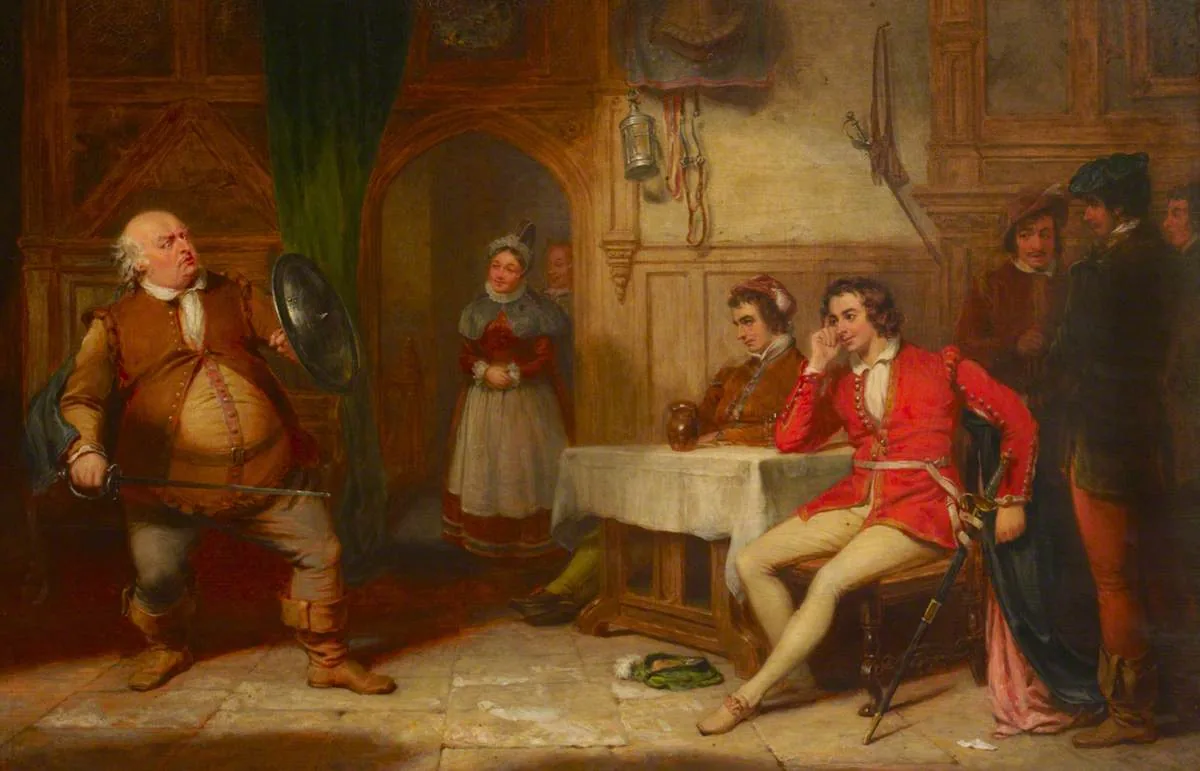
In Act 2 of Henry IV, Part 1, Falstaff recounts being robbed at Gadshill. With each retelling, the number of attackers grows, and he describes them as “three misbegotten knaves in Kendal green” who came up behind him. Prince Hal catches him at once. It was so dark, Hal says, that Falstaff could not have seen his own hand. How could he have known what color the men were wearing?
Falstaff’s line is the most famous mention of a cloth that most of Shakespeare’s audience would have known. Kendal green was ordinary English wool, and its green came from two dyes. The cloth was dyed yellow, then dyed again in blue.
Green is everywhere in the natural world, and natural green dye barely exists. Nearly every green garment made before the late nineteenth century was built from two other colors, and that is why this series saved it for last. Part Six covered the yellows; Part Eight covered the blues; green requires both.
The Most Common Color, the Rarest Dye
A child said What is the grass? fetching it to me with full hands;
— Walt Whitman, “Song of Myself,” 1855
How could I answer the child? I do not know what it is any more than he.
I guess it must be the flag of my disposition, out of hopeful green stuff woven.
Plants make up about 80 percent of all living matter on Earth, measured by carbon weight, according to a 2018 census of the biosphere published in the Proceedings of the National Academy of Sciences. Nearly all of it is land plants, which is why so much of the Earth looks green from the air.
The green in grass, moss, and every leaf on every tree comes from chlorophyll, the pigment plants use to capture sunlight. It is more abundant on Earth than any other colorant, and it’s nearly useless as a dye.
Chlorophyll’s color depends on a single magnesium atom held at the center of the molecule. Acid, alkali, heat, oxygen, and light can all knock it loose, and when the magnesium goes, the green goes with it. The pigment is also oil-soluble, so it has little reason to enter a water-based dye bath or stay in fiber that gets washed. A grass stain on the knee of a pair of jeans shows the problem on a small scale. It starts bright, fades to dull khaki, and disappears within a few washes.
Dye historians have counted how rare a true green is. In one survey of 93 natural dyes, cited by Chakraborty and Chakraborty (2014), only five were green. The textile scholar Harald Böhmer argues that no natural green dyestuff produces a permanent green color. To read as green, a molecule must absorb light at both ends of the spectrum, reds and blues, and let the middle through. Very few plant compounds do that, and the ones that do rarely survive a wash.
Nature often builds green the same way dyers did: from blue and yellow. A parrot’s green feather has no green pigment. The feather’s structure scatters blue light, and a yellow pigment the parrot makes filters that blue into green. A parrot born without the yellow is blue. Tree frogs work the same way, with a layer of yellow pigment cells over blue-reflecting cells. The exception is the turaco, an African bird whose green feathers contain a true green pigment called turacoverdin. It is built around copper, a metal I’ll come back to later.
↑ Table of ContentsGreen From a Single Plant
A few plants give green on their own, and most grow in Asia. The bark of several Garcinia trees, relatives of the mangosteen, gave green in Thailand, Cambodia, and parts of India. Indian dyers also got a range of greens from dhaincha (Sesbania aculeata), a fast-growing shrub farmers still plant to enrich rice fields. Its greens held up best with an alum mordant. Leaf greens also appear across the region, from papaya and cassava leaves in Flores to pandanus in Sumatra. Most of them faded fast. One Indonesian dyer’s green, made from a bean and turmeric, faded within a year. Most of these exceptions stayed local, but one reached Europe.
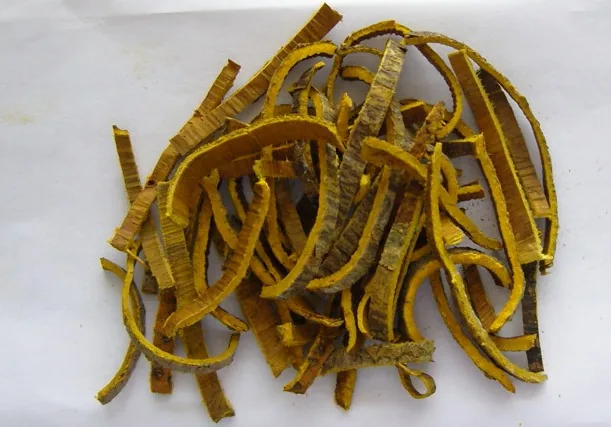
In 1848, the Mulhouse chemist and industrialist Daniel Koechlin-Schouch received a batch of Chinese textile samples collected by Charles de Montigny, the French vice-consul in Shanghai. One pale green cotton caught his eye. It had been dyed with something no one in Europe recognized, and the Paris chemist Jean-François Persoz confirmed it was a dyestuff of its own kind. The French called it vert de Chine. In China it was lokao, made from the bark of buckthorn shrubs (Rhamnus), and it gave green from a single dye, with no yellow and blue to layer. Its color also stayed bright under artificial light. Lyon’s silk dyers wanted it badly.
In 1852, the Lyon Chamber of Commerce approved 3,000 francs to buy five kilos from China, and in 1853, two greenhouses of buckthorn plants were shipped to France. The price climbed from 224 francs a kilo in 1845 to 533 in 1857. The craze ended almost as fast as it began. Lokao is not lightfast, and once synthetic dyes arrived, Europe forgot the one natural green it had spent so much effort finding.
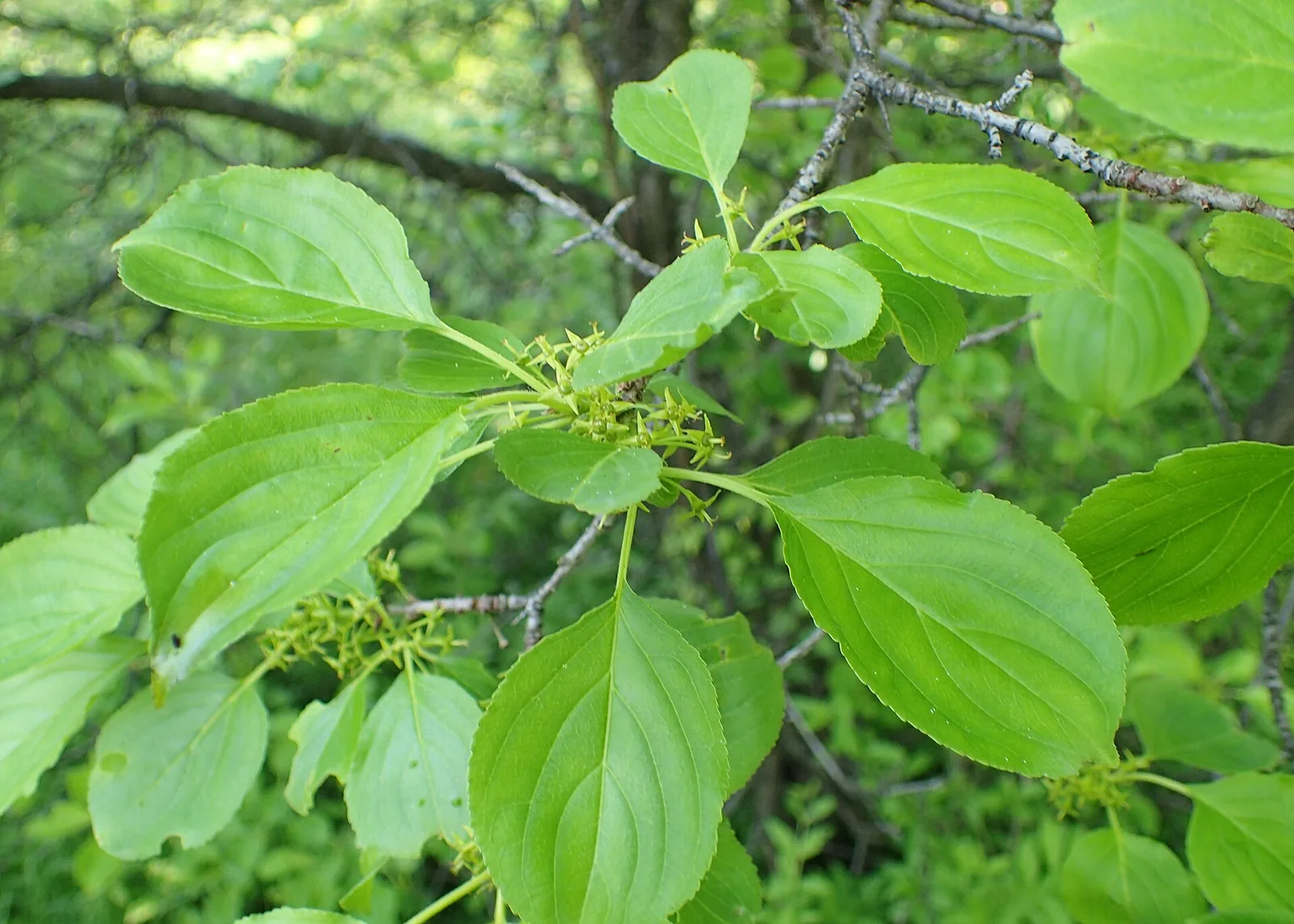
Lokao chemistry is still debated. Nineteenth-century chemists named the colorant lokain and assigned it a formula, but no modern study has determined its structure. Researchers have analyzed the bark and found that its main dye compounds are yellow flavonoids, the same family as weld’s luteolin. Whatever turned that yellow into green in a Chinese dyer’s vat remains unknown.
Most of these greens faded, and the rest stayed local. No single plant gave dyers a green that was both bright and lasting, so almost everywhere, they built green from two dyes instead.
↑ Table of ContentsOne Cloth, Two Dyes
If no dye holds green, the next best option is to combine yellow and blue. Layered in the same fiber, they read to the eye as one color.
If the two elementary colours are mixed in perfect equality so that neither predominates, the eye and the mind repose on the result of this junction as upon a simple colour.
— Johann Wolfgang von Goethe, Theory of Colours, 1810, translated by Charles Eastlake
That method is so universal that a 2004 study of historical Western textiles by Ferreira and colleagues found that greens were always made by overdyeing a blue with yellow. “Always” is a strong word, but it mostly holds up here.
The two halves of a green behave very differently, and the reason goes back to the beginning of this series. Part One explained the mordant chemistry that most yellows rely on. Weld, dyer’s greenweed, and fustic bond to fiber through a metal such as alum, which ties the dye molecule to the cloth. Indigo works nothing like that. It never bonds to anything. It soaks into the fiber in its soluble form and gets trapped there when it oxidizes back to blue. A green dyer must apply two different chemistries on the same piece of cloth, one after the other.
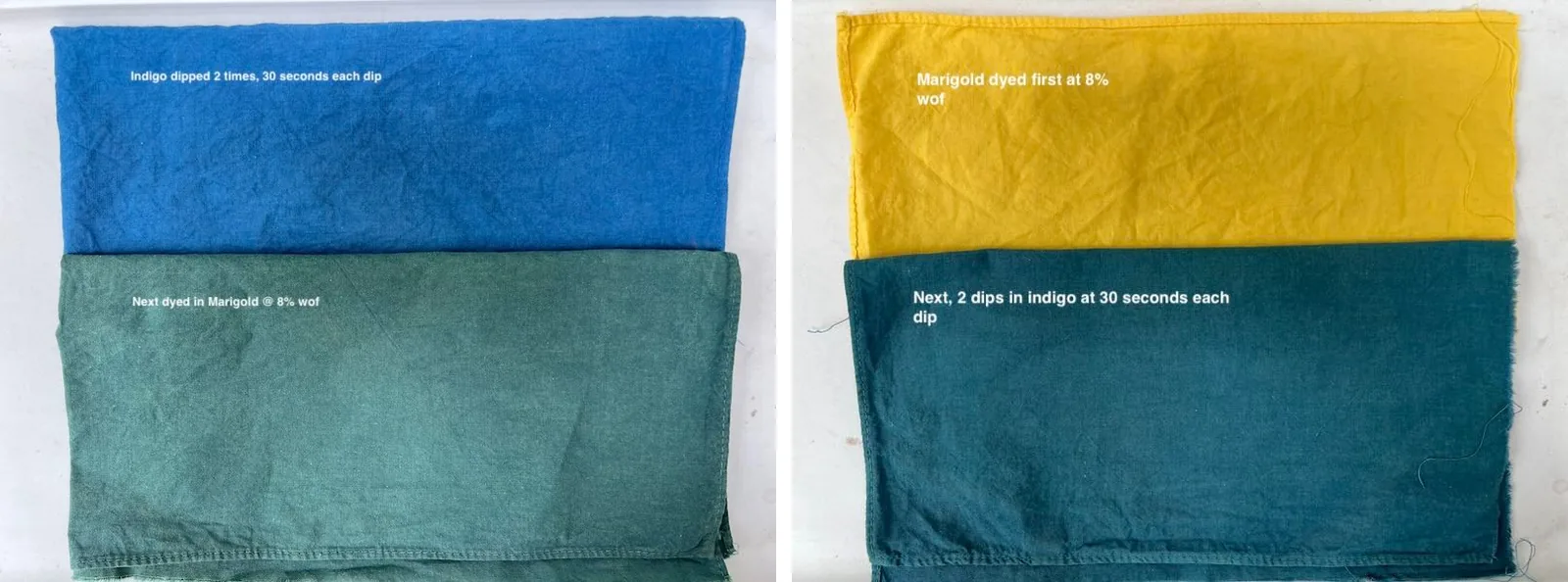
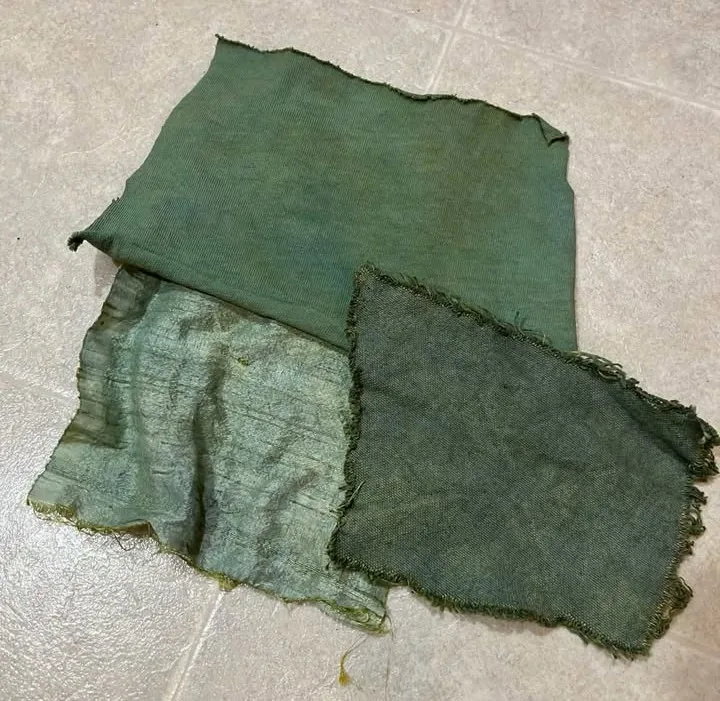
The order could go either way, and the choice changed the result. Kathy Hattori of the dye supplier Botanical Colors starts most of her production greens with a light indigo and puts a strong yellow on top, which she finds easier to control. Many dyers do the reverse. In a side-by-side test, Hattori found the order alone changed the color: indigo first gave green, and marigold first gave a dark teal. Each layer’s strength mattered as much as the order. A pale yellow under a few indigo dips made a blue-green. A strong yellow under a single light dip made something close to lime.
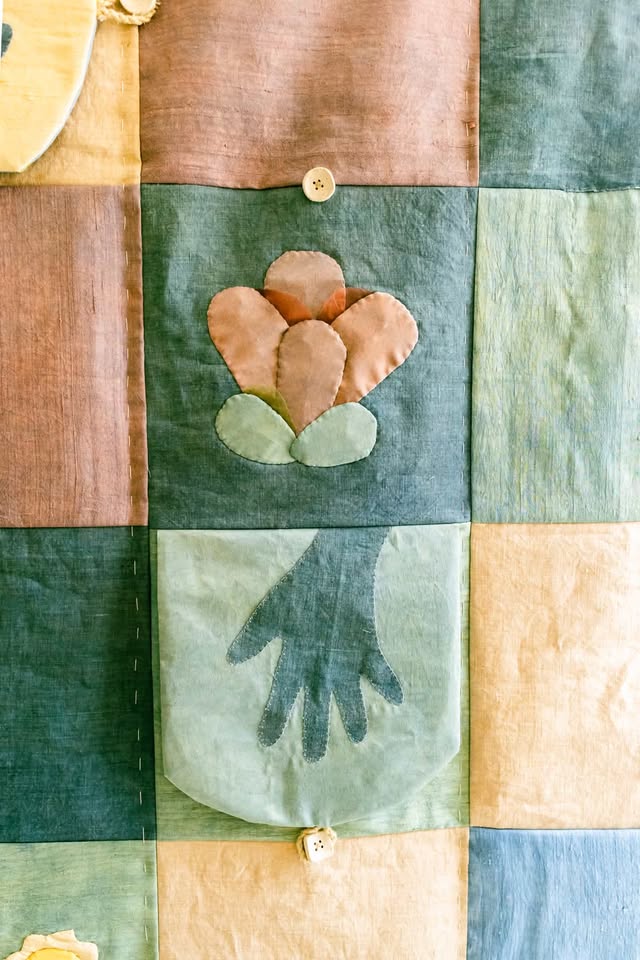
Kendal Green
The best-documented English green is named after a town. Kendal, in what was then Westmorland and is now Cumbria, made woollen cloth for centuries, and the term Kendal green first appears in English in the early 1500s.
The recipe started with dyer’s greenweed (Genista tinctoria), a low, yellow-flowered shrub in the pea family that grows wild on rough pasture. Its yellow comes from luteolin, the same molecule that colors weld. Wool was mordanted with alum, dyed yellow with greenweed, and then overdyed with woad, the European blue whose history Part Eight traced through the mills of Lincolnshire and the merchants of Toulouse. Later, as imported indigo replaced woad, Kendal’s dyers switched to indigo for the blue half.
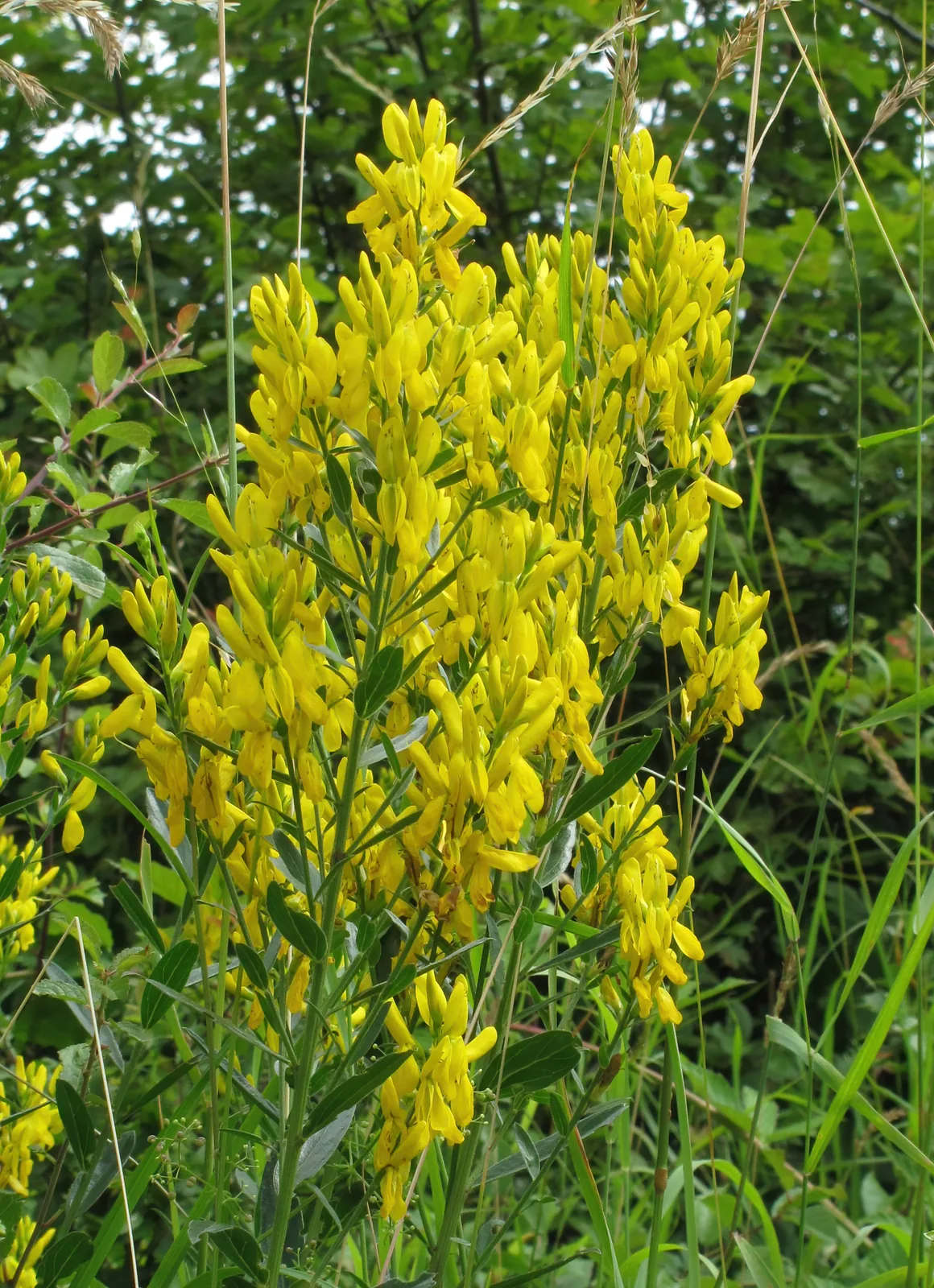
Kendal green fell out of use, but greenweed did not. It was grown commercially as a yellow dye in parts of Britain into the early nineteenth century. Today the plant is rare. It has declined sharply in the wild since the 1950s and is now listed as endangered in Great Britain.
Kendal green was common enough that Shakespeare could drop it into Falstaff’s mouth and trust every attendee could visualize the cloth.
↑ Table of ContentsLincoln Green and Robin Hood
Kendal’s best-known neighbor in the history of English green is Lincoln green, the color of Robin Hood and his men. Lincoln was a major cloth town in the Middle Ages, famous for its dyed wool, and the first recorded use of Lincoln green as a color name in English dates to 1510.
The recipe is less understood. Most accounts describe woad overdyed with a yellow. Some name weld as the yellow, and others name dyer’s greenweed. Some put the woad first, and others put it second. The disagreement matters less than it seems, because weld and greenweed share the same main colorant, luteolin, so the dye chemistry was the same either way.
Assuming greenweed was the yellow, Lincoln green may have been dyed almost exactly like Kendal green. Both names first appear in written English within a few years of 1510, so the dates alone don’t separate them. The town makes the difference. Lincoln’s cloth industry was older, with guilds of weavers, dyers, and fullers by 1216, and in 1612 the poet Michael Drayton described Lincoln as the town that “anciently dyed the best green in England.” Kendal’s cloth sat at the other end of the market. By 1500, Kendal green was a coarse, hard-wearing wool, woven in homes across Westmorland, finished in the town, and worn mostly by working men. A writer observed in 1550 that a serving man was content to go “in a Kendall cote in summer.”
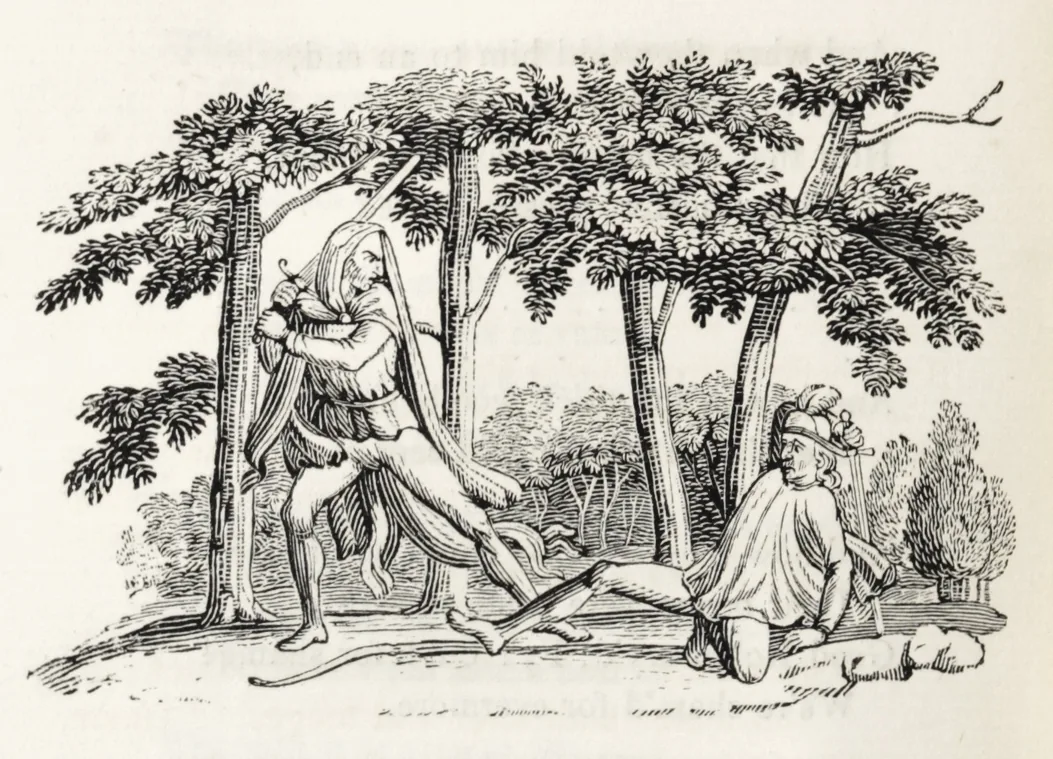
One of the earliest Robin Hood poems, A Gest of Robyn Hode, printed around 1510, highlights the color’s significance. Near the end, the king, disguised as an abbot, reveals himself and pardons Robin. Then he asks to buy some of Robin’s green cloth, and he and his knights trade their gray monks’ habits for it: “Whan they were clothed in Lyncolne grene, / They keste away theyr graye.” Dressed as Robin’s men, they ride into Nottingham as a joke. The townspeople see “nothynge but mantels of grene,” decide the outlaws have killed the king, and run. Green was the outlaws’ color. The French historian Michel Pastoureau, in his history of the color, calls green the color of the hunt and the forest, and of disorder and transgression.
By the late sixteenth century, Lincoln green had fallen out of use. Its name outlived the cloth by centuries, mostly through the Robin Hood stories.
↑ Table of ContentsSaxon: Green in One Bath
The next big change in European green came from a change in blue. In Germany in the 1740s, dyers found that indigo could be dissolved in strong sulfuric acid and then neutralized, producing a liquid blue that could go straight into a dye bath without a fermentation vat. They called it Saxon blue, after Saxony, where they developed it.
Saxon blue was different from vat indigo. It worked best on wool, gave a brighter and slightly greener blue, and was far less fast to washing. It was also convenient. A dyer could add Saxon blue into a pot of yellow, usually fustic, the morin-rich dye wood from Part Six, and produce green in one bath instead of two. They sold the result as Saxon green.
That convenience came at a price. Kendal green was two fast dyes layered in sequence. Saxon green traded some durability for brightness and speed, which the mid-18th-century market prioritized.
↑ Table of ContentsWhy Old Greens Turn Blue
Every overdyed green carries the same flaw. Its two halves age at different speeds.
In Part Six, I described weld as the most lightfast yellow, but it still does fade. Indigo fades far more slowly. Over decades and then centuries, the yellow layer breaks down in the light while the blue underneath holds. Green drifts toward blue-green and, in the worst cases, to plain blue. Conservationists routinely see blue foliage, blue grass, and blue trees in medieval and Renaissance tapestries that were green when they were woven.
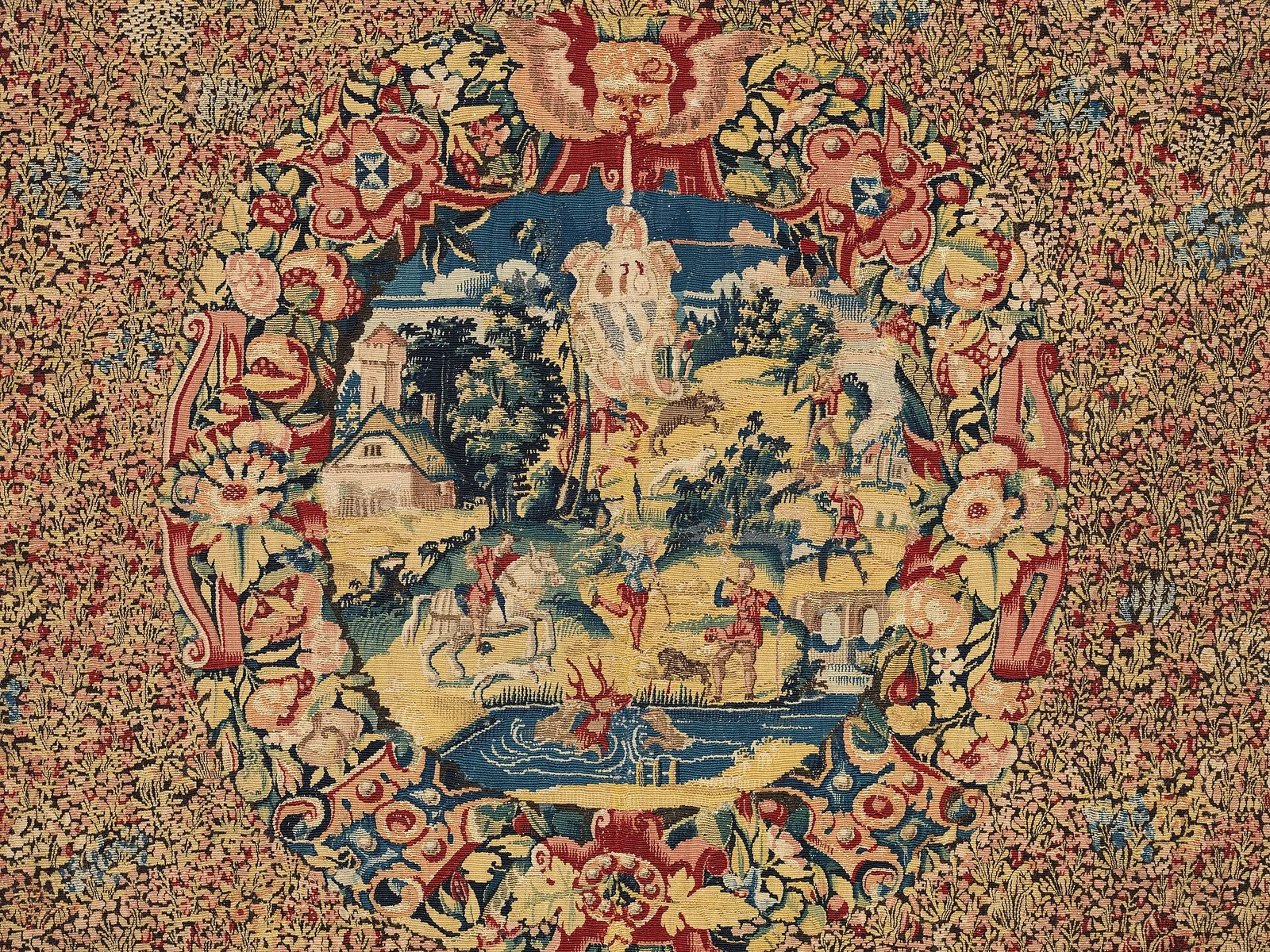
It happened in Asia too. Old Indian chintzes, woodblock-printed textiles made from unprocessed cotton, show the same drift, with greens that were turmeric over indigo now reading blue because turmeric is one of the least lightfast dyes.
Painters had their own version of the problem. Sap green, a pigment made by boiling unripe buckthorn berry juice with alum into a thick syrup, was sold in pig bladders and used by manuscript illuminators and watercolorists for centuries. The Italian painter Cennino Cennini recorded it around 1360 and warned it wouldn’t last. He was right, and painters kept using it anyway because a faded green was still better than no green at all.
↑ Table of ContentsGreens of the East
Across South and Southeast Asia, dyers made green the same way. The blue was almost always indigo. The yellow came from whatever was in each region.
In Sikka, on the Indonesian island of Flores, dyers made green by overdyeing indigo with turmeric. In Cambodia, dyers overdyed indigo on a yellow from mango bark. In Timor, an Amarasi textile from 1828 shows a sea-green made by combining indigo with morinda, and its chief recalled that green once came from indigo over kayu kuning, a yellow wood. Weavers there still overdye indigo with jackfruit, the same heartwood that colors Buddhist monastic robes in Part Six, and with mango bark. Both are more durable yellows than turmeric.
Japan used the same method with its own plants. Kihada, the yellow inner bark of the Amur cork tree that Part Six met with safflower orange, was dyed first and then dipped in indigo. The depth of the yellow and the number of dips decided the shade. Green cloth made this way grew more popular in the Muromachi period, as tea-ceremony aesthetics rose. Gardenia yellow under indigo made green the same way.
The Color of Paradise
In the Quran, the people of paradise wear green. They “wear green garments of fine silk and rich brocade” (18:31), and they recline on green cushions (55:76). A hadith describes the Prophet himself wearing two green garments.
Green marked the Prophet’s family. In the Ottoman Empire, his descendants, the sayyids, wore green turbans, and an official called the naqib al-ashraf checked claims to that descent and certified the ones he accepted. Nicolas de Nicolay, a sixteenth-century French traveler, described the green turbans he saw in Ottoman society. In Syria, the green turban was still reserved for the Prophet’s descendants in the 1960s.
The Ottomans’ great rival to the east, Safavid Persia, shows how they made such greens. When scientists at the Metropolitan Museum of Art analyzed fifteen Persian silk velvets from the sixteenth to eighteenth centuries, they found that every green thread they tested was indigo overdyed with yellow. The yellow was most often yellow larkspur (Delphinium semibarbatum), a dye plant Persians called isparak.
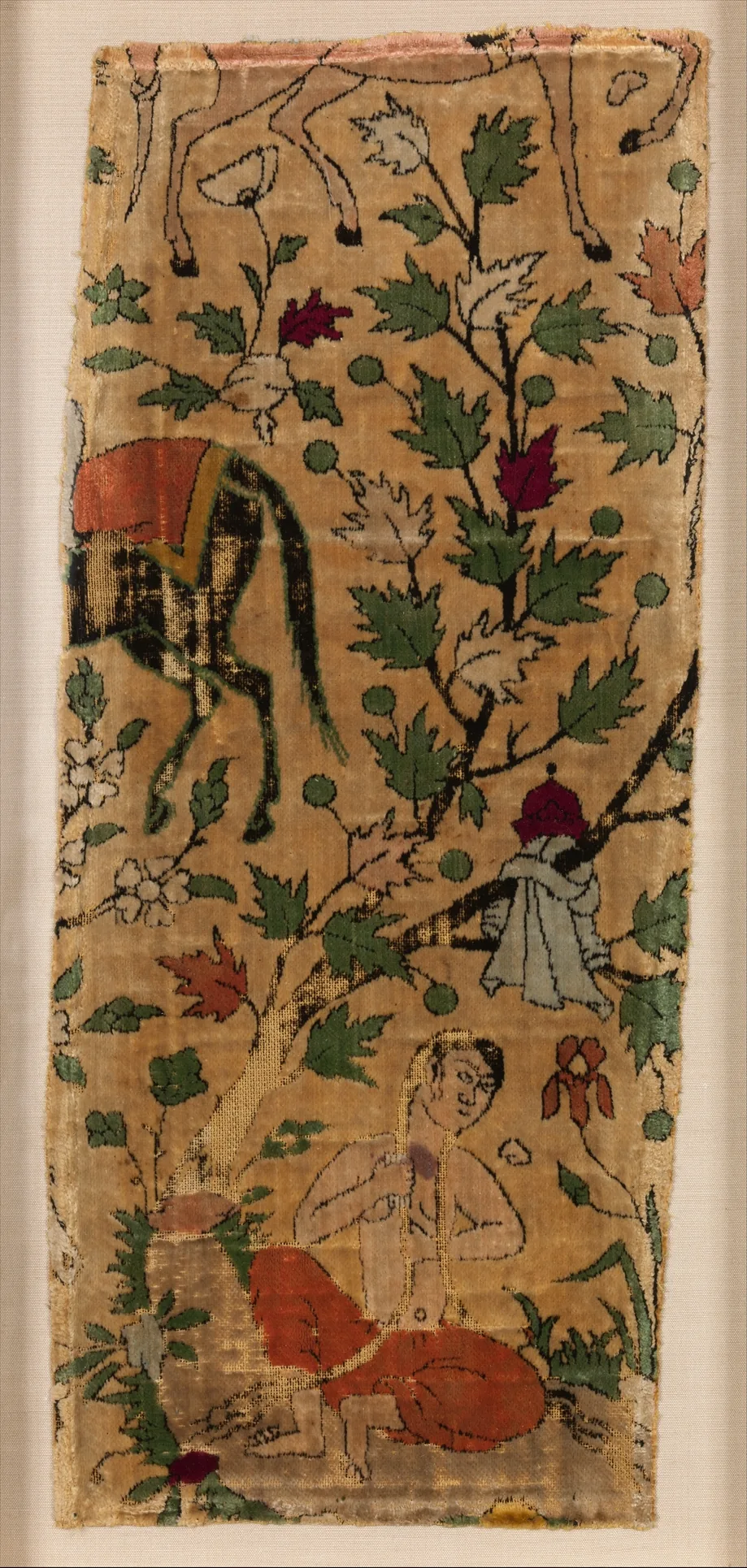
Before synthetic dyes, an honor written in green depended on a color that was hard to make and hard to keep.
↑ Table of ContentsGreens Without Blue
Part One explained why a mordant metal changes a dye’s color. Aluminum has no electrons that absorb visible light, so alum leaves a dye’s color nearly untouched. Iron and copper absorb light, so they shift the dye’s color. Iron saddens, darkening and dulling. Copper pushes toward green and olive. In Part One’s madder chart, copper turned the red to olive.
On a yellow dye, copper pushes the garment toward green. A copper sulfate bath after a yellow pulls the color toward a brighter green or blue-green than iron can reach. Copper still does not make green by itself, though. It only shifts a color that a yellow dye has already put on the cloth.
Iron does something similar. In 2025, the natural-dye studio Farm & Folk published results from dyeing linen yellow with osage orange, weld, dyer’s chamomile, and marigold, then dipping it in a weak iron bath. The iron shifted the yellows toward an olive green, the same reaction that turns madder blue-black in Part One and onion skin moss in Part Six. These greens are earthy rather than bright, and less predictable than copper.
Yellow weld on unbleached linen, naturally gray-tan, appears as green without a mordant. Weld, which yields a neon yellow-green on white linen, became chartreuse on unbleached linen. Marigold gave what the studio called “froggy greens.” The fiber’s gray color did the job a metal would otherwise do.
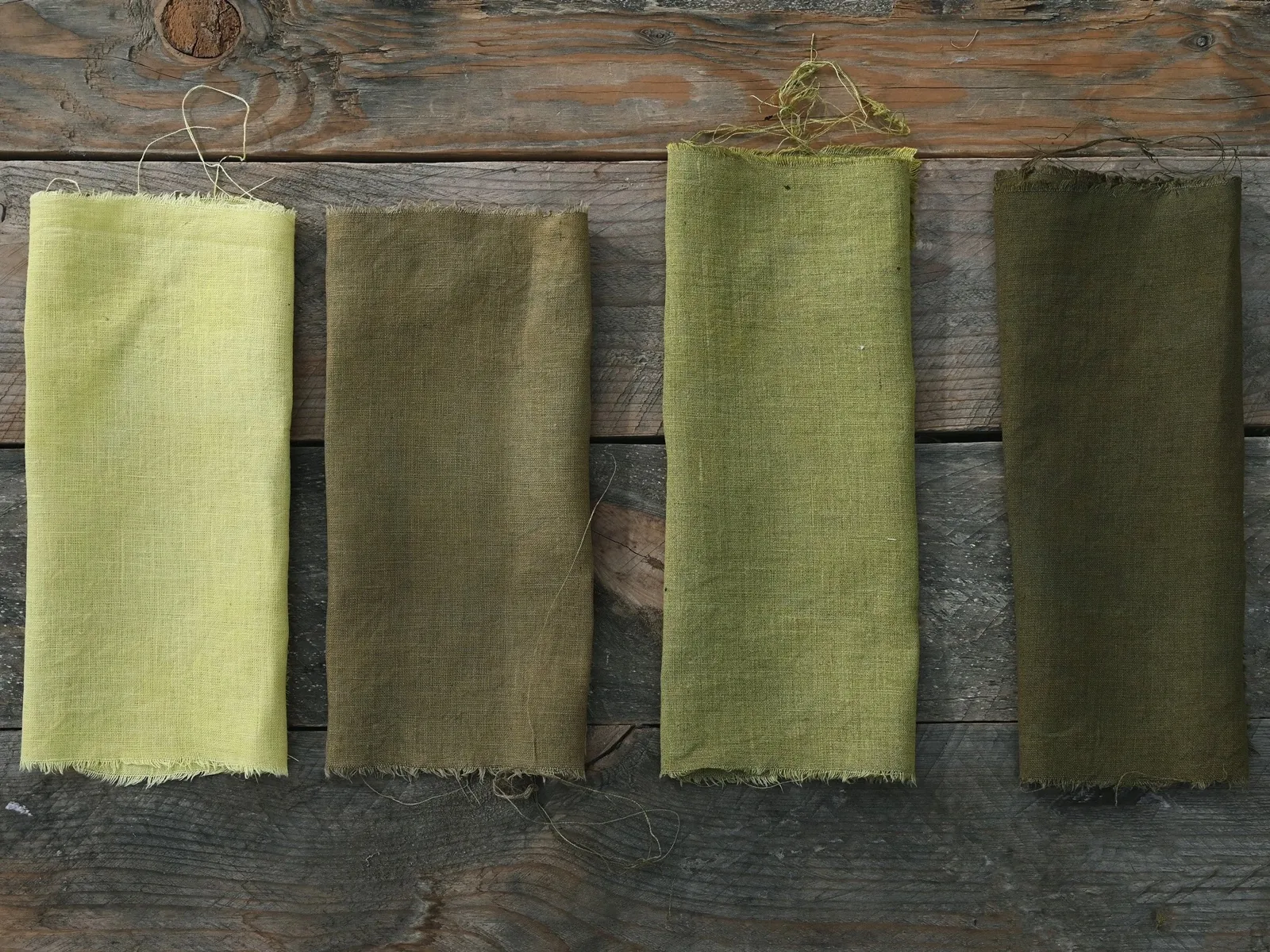
Japan gave its iron greens names. Kariyasu, a yellow-dyeing grass, turns a moss green called uguisu-iro, after the bush warbler, when iron is used as a mordant. Kihada bark, dipped again and again and finished with iron, gives miru-iro, an olive named for a seaweed.
Dyer’s polypore (Phaeolus schweinitzii), a fungus that grows at the base of conifers, dyes wool a bright yellow. An iron afterbath turns that yellow dark olive or moss green, as kariyasu and kihada did.
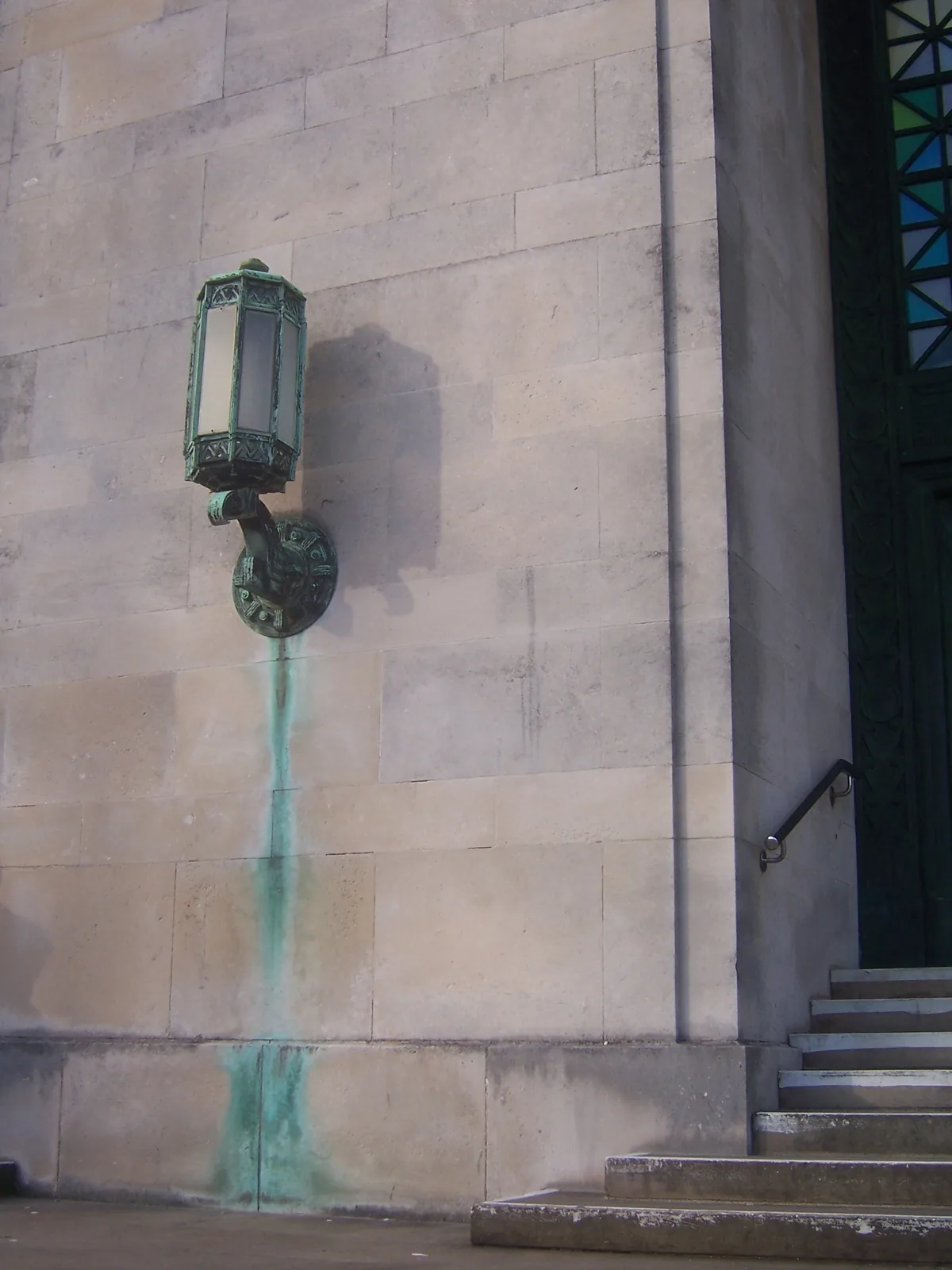
Copper also gave the world one of its oldest green pigments. Verdigris is the green crust that forms on copper as it corrodes, and people learned to make and utilize it. Ancient writers described suspending copper over vinegar. By the eighteenth century, producers around Montpellier, in southern France, stacked copper sheets with fermenting grape skins left over from winemaking and scraped off the green. Verdigris colored paint and parchment for centuries. It was never used as a garment dye, only a pigment, and like everything else in this essay, it didn’t hold.
The Color That Killed
When chemistry finally produced a bright, single-source green, it was poison.
In 1775, the Swedish chemist Carl Wilhelm Scheele made a copper arsenite pigment that gave a yellow-green brighter than anything that the previous four centuries of overdyeing had managed. Scheele’s green was cheap and vivid, and it darkened over time. In 1814, a paint maker in Schweinfurt, Germany, Wilhelm Sattler, began manufacturing a deeper, more stable version, copper acetoarsenite. It was known as Schweinfurt green, emerald green, and Paris green.
For a few years, its makers kept the recipe secret, and buyers didn’t know what it contained. In 1822, chemists Justus von Liebig and Henri Braconnot published how it was made, and the secret was out: the new green contained arsenic. Emerald green spread anyway. It colored wallpaper, paint, printed paper and cloth, artificial flowers, and even candy. By the early 1830s, Europe recognized the danger, and by 1845 several countries had banned it. The color stayed in use for decades after that. William Morris was still printing wallpapers with arsenical green into the 1880s.
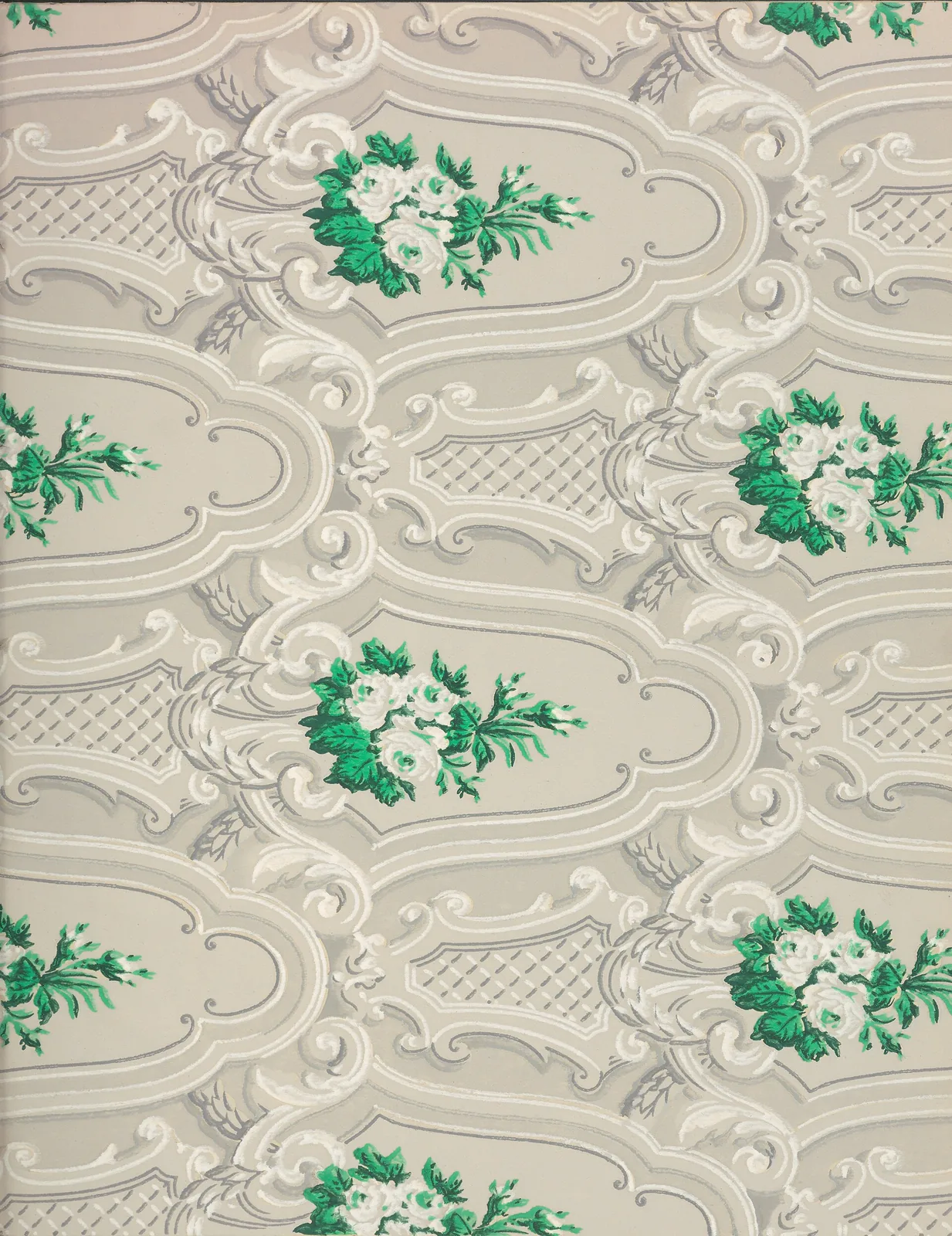
The worst of the harm fell on the people who made the goods. On November 20, 1861, Matilda Scheurer, a 19-year-old artificial-flower maker, died in London. Her job was dusting green powder onto fabric leaves for headdresses and wreaths, work that put the pigment on her hands, in her food, and in the air she breathed all day. At the inquest, her mother described her vomiting a fluid that was “of a very greenish colour.” The autopsy found arsenic in her stomach, her liver, and her lungs. Her death was covered widely, and it pushed public attention onto a whole trade of workers handling the same powder every day.
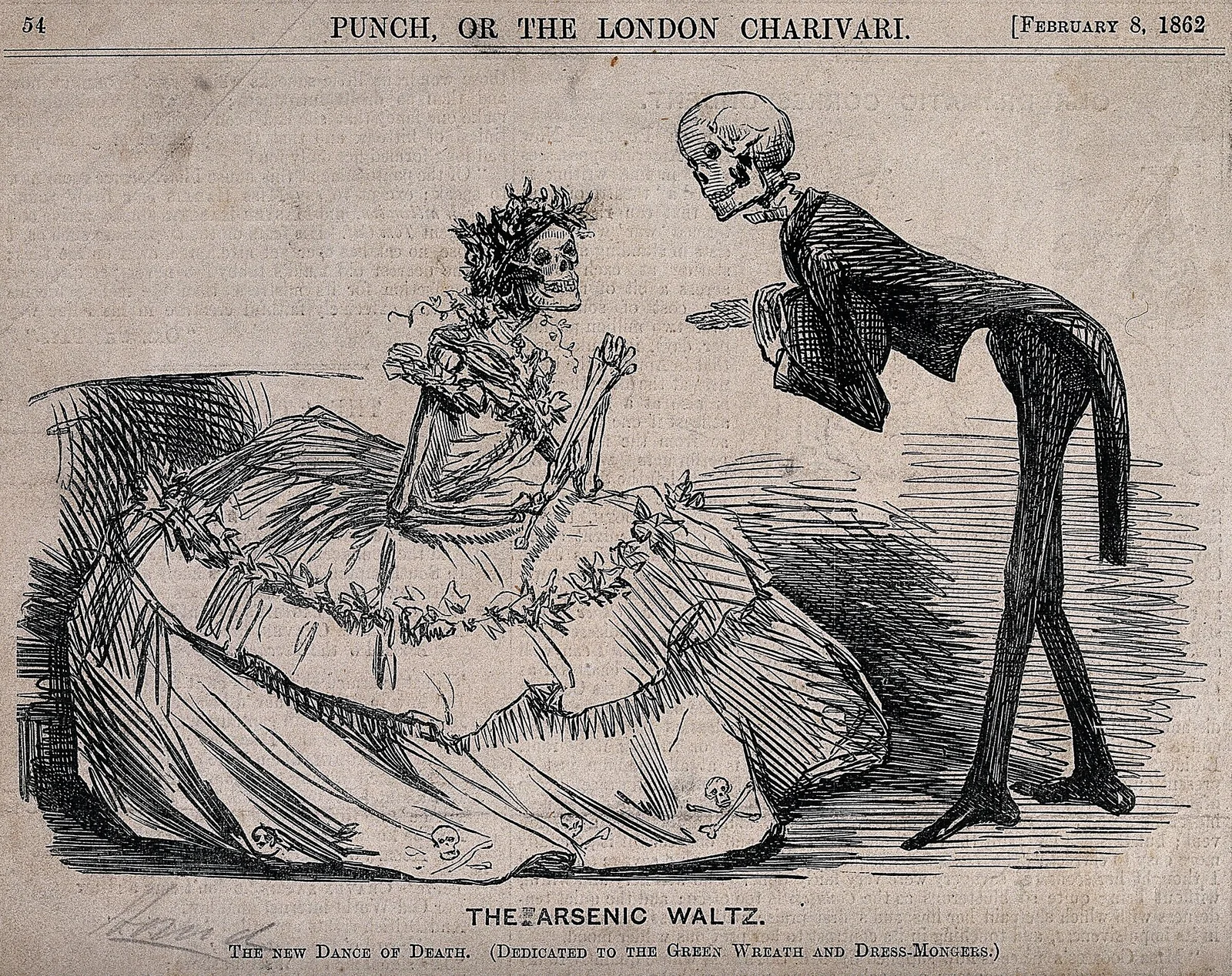
Arsenical green did not disappear because of one death, but for two reasons. It poisoned people, and it was chemically unreliable, darkening in the sulfur-filled, coal-smoke air of industrial cities. The brilliance people bought it for did not last either.
↑ Table of ContentsThe Chemists’ Green
The synthetic dye industry that Parts Four and Eight followed through alizarin and indigo struggled more with green.
The first aniline greens of the 1860s were bright and fugitive, like every natural green before them. Malachite green, introduced in 1877, was much more stable, and Caledon Jade Green, a vat dye launched in 1920, finally gave the textile industry a green that held up to light and washing. For the first time in dyeing history, a single dye could reliably make cloth green. By the 1950s and 1960s, lightfast synthetic greens had reached even remote weaving communities, and today nearly all green cloth is synthetically dyed.
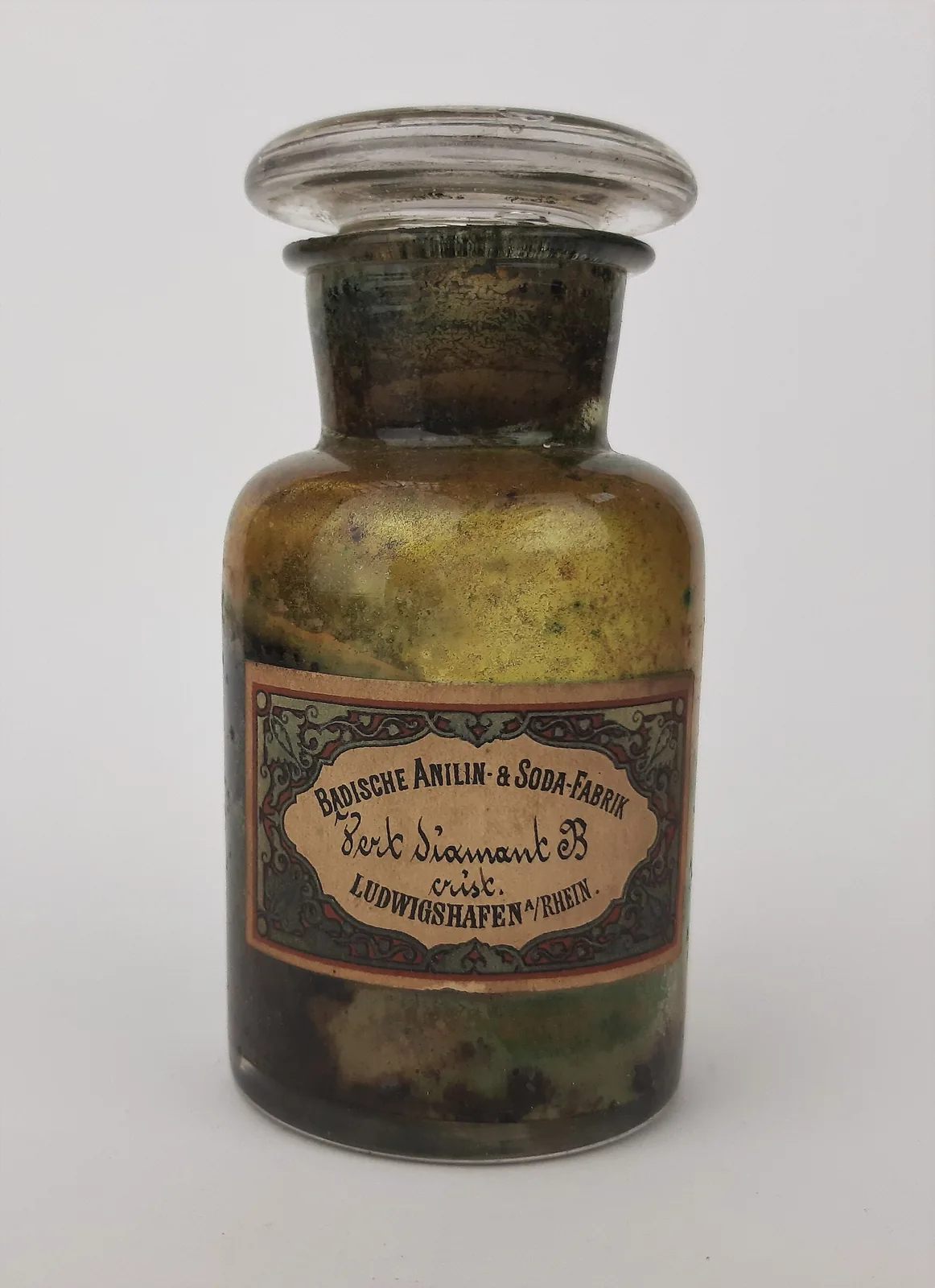
Chlorophyll got its own modern fix. Chlorophyllin, sold as a natural green dye, is chlorophyll with its magnesium swapped for copper, making it water-soluble and stable enough for a dye bath. Dye suppliers say it is still less lightfast than classic natural dyes. The best modern answer to chlorophyll’s weakness turned out to be copper, the same metal dyers had been using for green all along.
↑ Table of ContentsModern Makers
Overdyed green survives today as a reproduction of old traditions. Few labels build a collection around it. The makers below run from work shirts to silk scarves to wide-leg pants.
Some of the links below are affiliate links. If you buy through one, I may earn a small commission at no cost to you.
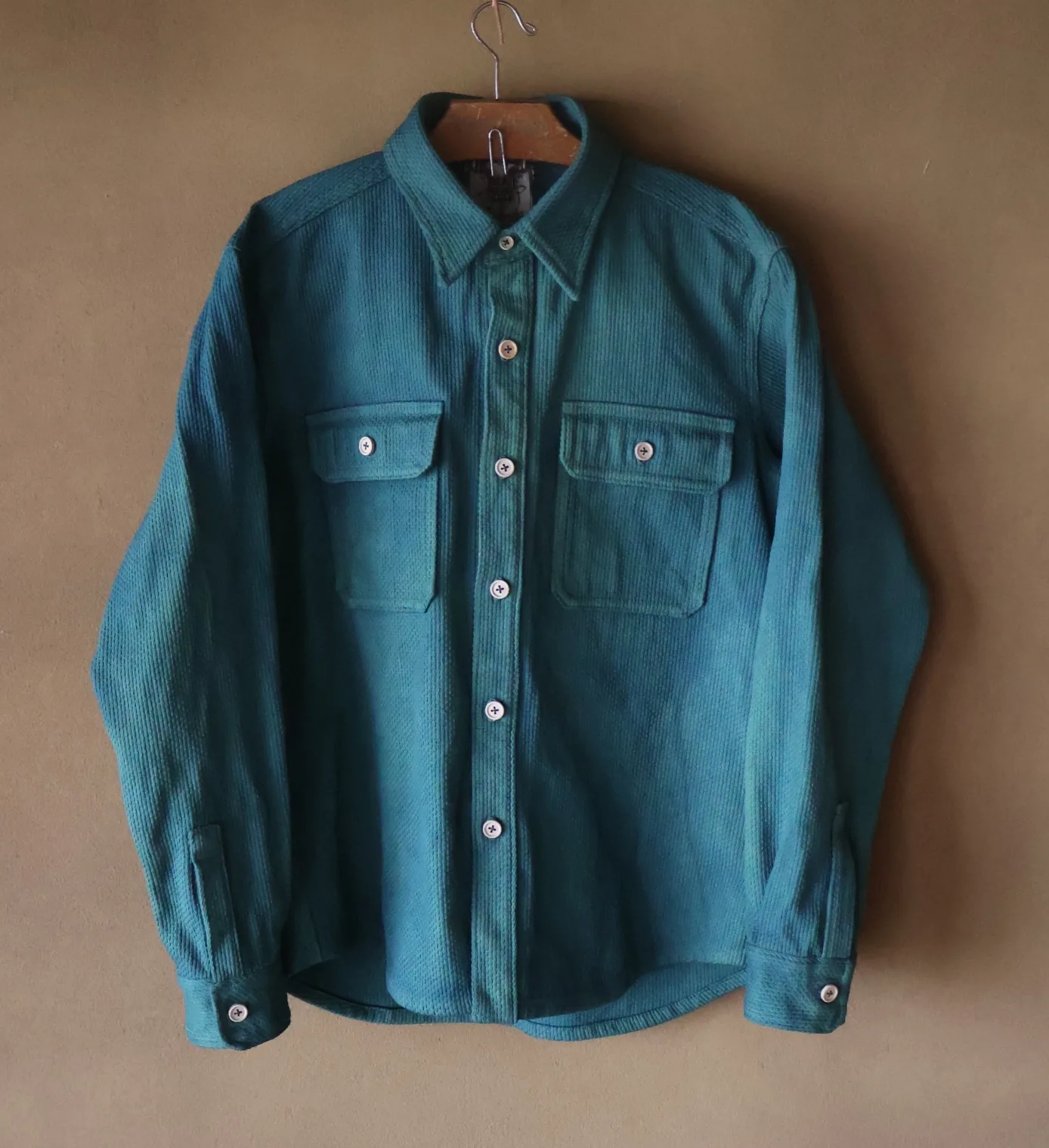
Wild Frontier Goods, Japan. The Green Indigo version of the WFG Overshirt. The Japanese selvedge sashiko cloth is hand-dyed first in pomegranate, which gives yellow, and then overdyed in natural indigo. Each shirt is made to order, and WFG also takes custom dye requests.
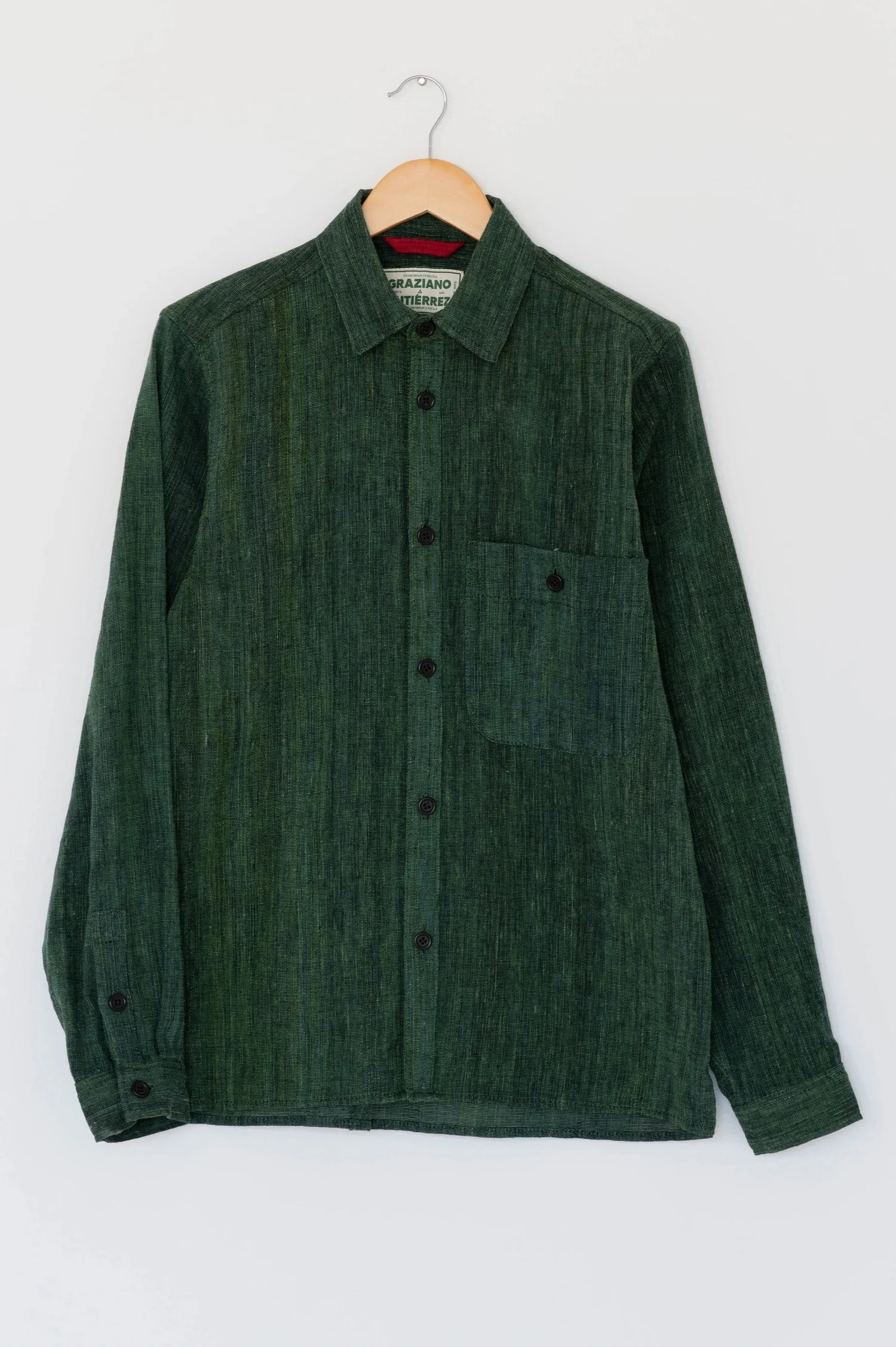
Graziano & Gutierrez, Portland. Part Six met this artisan through pericón, the wild marigold its Oaxacan weavers use for yellow. The Forest Pintor Shirt puts that yellow under indigo. Khadi Oaxaca, a collective in San Sebastián Río Hondo whose artisans grow, spin, dye, and weave their own cotton, gives the thread a fresh pericón bath, then an indigo bath, leaving streaks of yellow and green through the cloth. It follows Kendal green’s order: yellow first, then blue, with both dyes grown in Oaxaca.
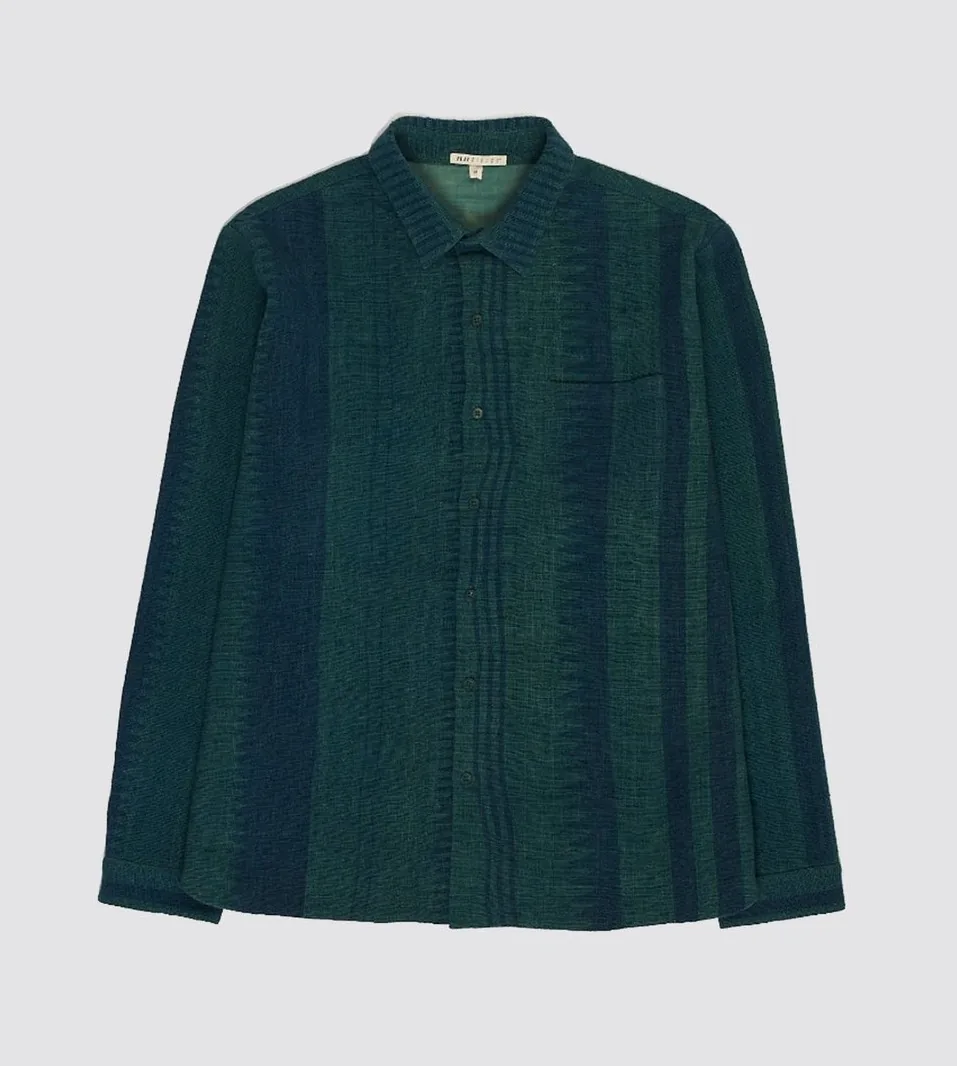
11.11, India. The label works with hand-spinners, weavers, and dyers across India, and its Bottle Green runs through dozens of pieces. Most of those listings name the dyes as indigo and myrobalan, the same yellow tannin Story mfg. pairs with iron below. The Block Print Unisex Shirt is handspun, handwoven cotton, block printed in that green.
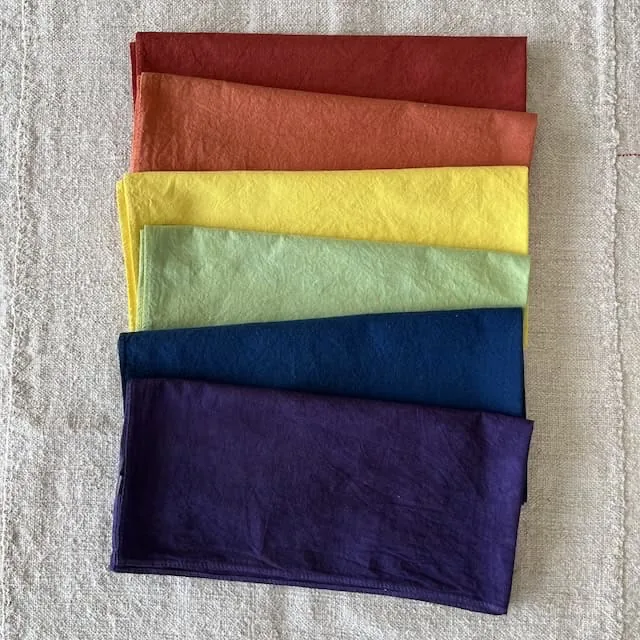
Botanical Colors, Seattle. Kathy Hattori’s dye house isn’t a clothing label. It dyes for other brands, including Converse, Eileen Fisher, Harvest & Mill, Madewell, Older Brother, and more. It has dyed collections for Eileen Fisher in indigo, madder, and pomegranate, and Part Eight credited it with the natural indigo overdye on a Shoes Like Pottery × Blue Owl Workshop sneaker. Its shop supplies smaller dyers with weld, osage orange, fustic, and indigo as concentrated extracts, the ingredients of a layered green. Its published method for a green bandana starts with a yellow from weld or osage orange, then adds indigo, with a light dip giving lime and a medium dip giving teal. It also sells chlorophyllin, the copper-stabilized descendant of chlorophyll.
The next three makers use iron instead of indigo, yielding an olive color.
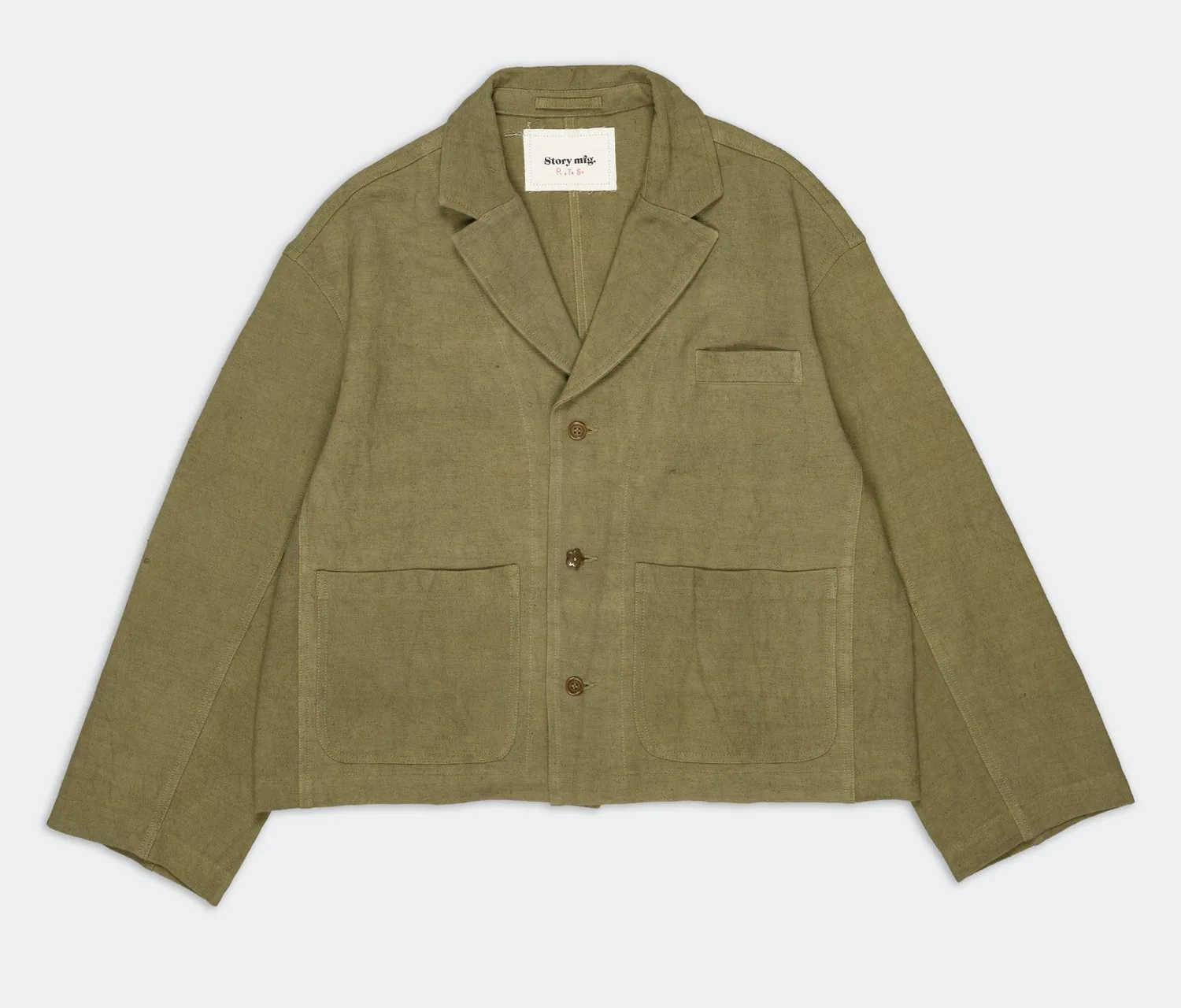
Story mfg., London. The CO-11 colorway reaches green without blue. Story mfg. dyes it with kaduka, the Indian name for myrobalan, the tannin yellow from Part Six, and then with iron. The label says a low concentration of iron with myrobalan makes olive and a high one makes black. On pieces like the Isil Jacket, cut from a handwoven cotton-hemp, CO-11 reads as a warm olive-green.
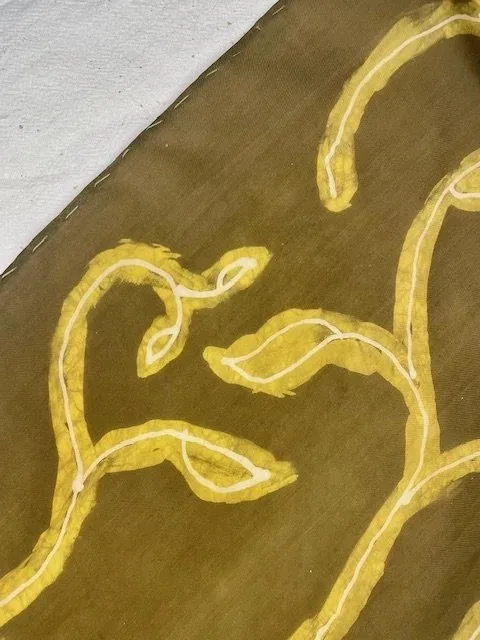
Imprint Collective, Colorado. This silk scarf shows the iron shift in a single piece. It was dyed with osage orange and iron, with three layers of batik, a resist drawn in hot wax. The vines read as osage’s yellow and the ground around them as olive, so the yellow shows before and after iron, side by side.
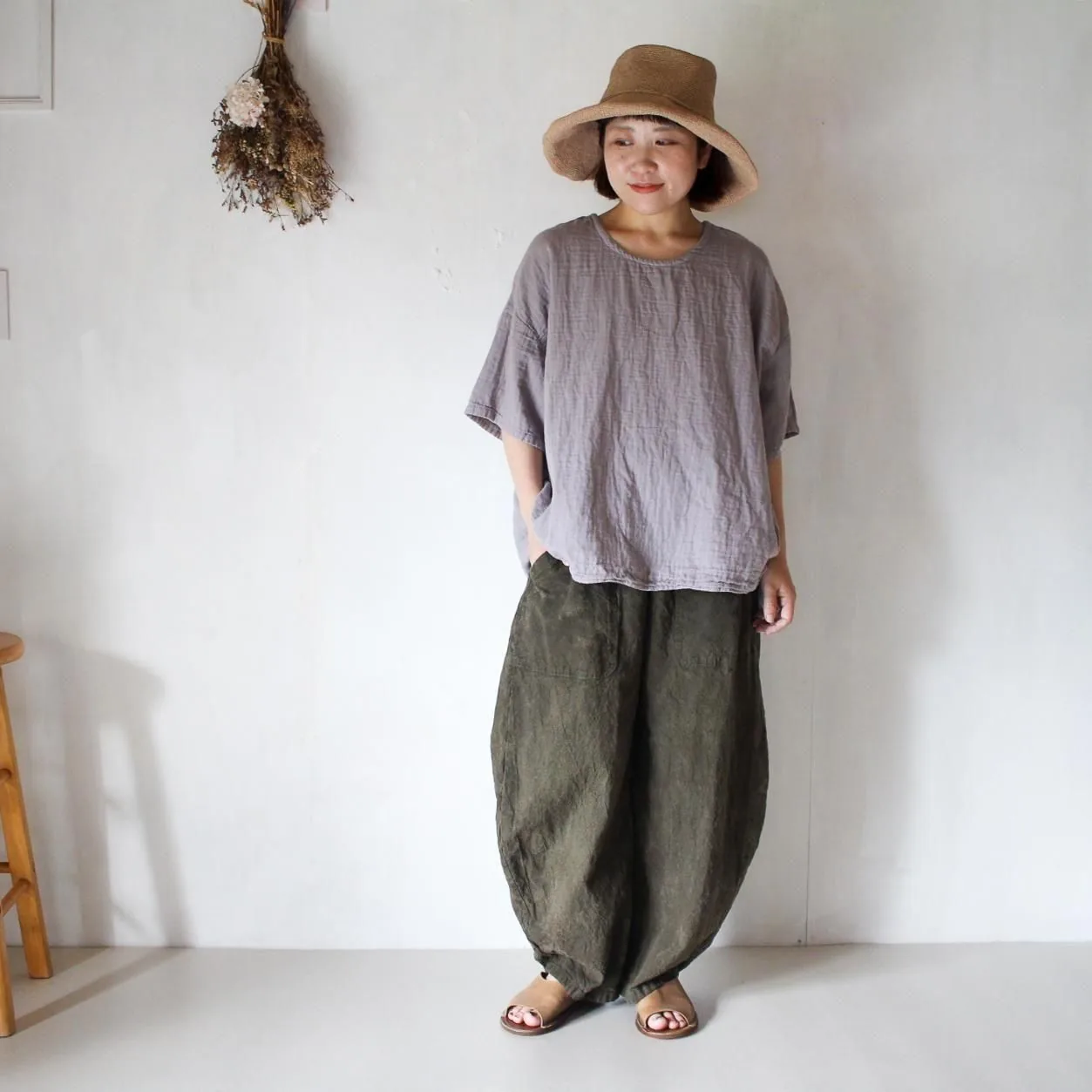
ISTIST, Japan. This small plant-dye clothing shop shows both roads to green in one catalog. Its miru-iro comes from bayberry bark, yamamomo, a Japanese dye used since the Nara period, mordanted with iron to what the shop calls deep khaki. Layering the same bayberry under Indian indigo creates tokusa-iro and chitose-midori, two deep greens. The saBo wide pants, in a cotton-linen canvas, demonstrate the iron version.
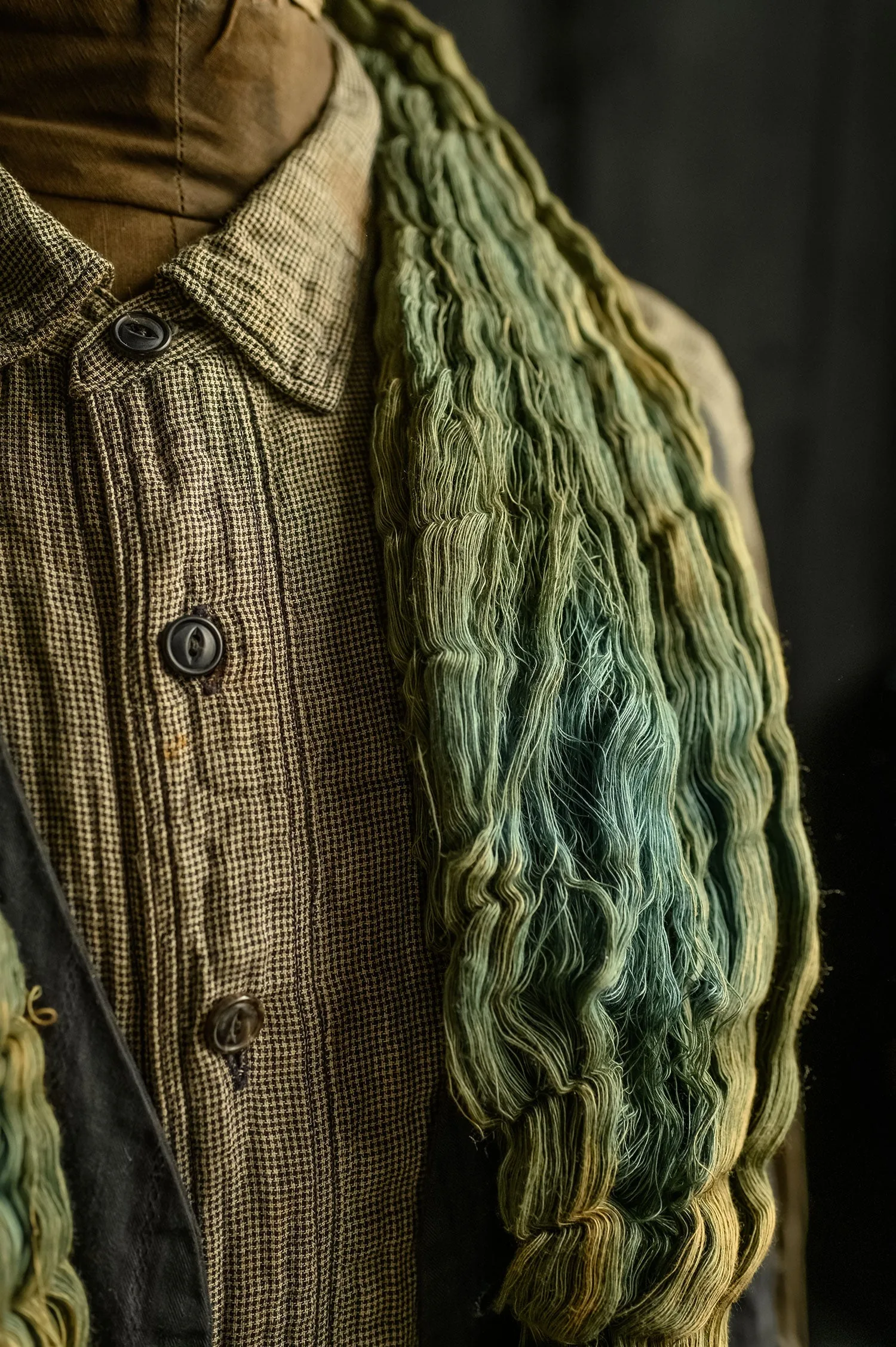
MadeWorn. The Washed Green scarf may be the one green on this list, dyed in a single dye. It was hand-dyed in indigo in Japan, and MadeWorn says the oxidation was arrested after dyeing to keep the color from turning the more common blue. Part Eight described that turn: indigo leaves the vat yellow-green and goes blue in the air. The listing doesn’t explain how a cloth could stop partway through that change and stay there through wear and washing, but I’m very interested in finding out.
The Final Color
This series started with a question about bonding: why some dyes grip a fiber, and others never do. Indigo traps itself mechanically. Madder and weld need a metal bridge. Walnut and myrobalan bond on their own. Purple from a snail changes color in the sun, and every one of those facts decided who could make a color, where, and at what cost.
Green comes last because it depends on everything before it. A green needed a yellow from Part Six that would bond through a mordant from Part One, and a blue from Part Eight that would trap itself in the fiber. It needed a dyer who understood both chemistries and could run them in sequence on the same cloth. It still faded unevenly, blue outlasting yellow, until museum tapestries turned their forests blue.
When chemists finally made a green that came from one source, it was copper and arsenic, and it killed the people who made it. A single green that held up to light and washing did not arrive until 1920.
The color covering every field and forest on earth proved the hardest to put on cloth. For most of history, a green coat was a yellow coat dyed blue, and the knaves in Kendal green who came at Falstaff’s back in the dark were wearing two colors.
This is the final part of Built for Color. Thank you for reading all nine. If you came here for the denim, the Fit Finder can help you find jeans that measure like a pair you already own, with suggestions based on real garment measurements.