In 1915, Levi Strauss & Co. representative Simon Davis approached a cotton mill in Greensboro, North Carolina, and the two sides shook on an agreement that made it Levi’s main denim supplier. The mill was White Oak, and the relationship, which the denim world refers to as the Golden Handshake, was a verbal agreement, not a contract. That agreement outlasted two world wars, a stock offering, a hostile takeover, and a bankruptcy before the plant closed on December 31, 2017. During that century, the company made some of the world’s most sought-after denim, and collectors still chase it nearly a decade after the plant closed.
A Cotton Company Before It Was a Denim Mill
White Oak was part of Cone Mills, but Cone didn’t start as a denim company. Moses and Ceasar Cone, sons of a Bavarian immigrant dry-goods merchant, founded the Cone Export and Commission Company in New York in 1891 to sell Southern cotton mills’ output to Northern buyers. Within a few years, the brothers realized it made more sense to own mills than to broker for them, and in 1895 they built Proximity Cotton Mill in Greensboro. This was the moment when Cone stopped selling cloth and started making it.
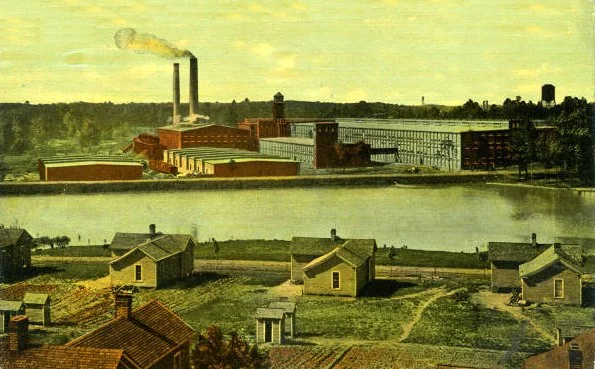
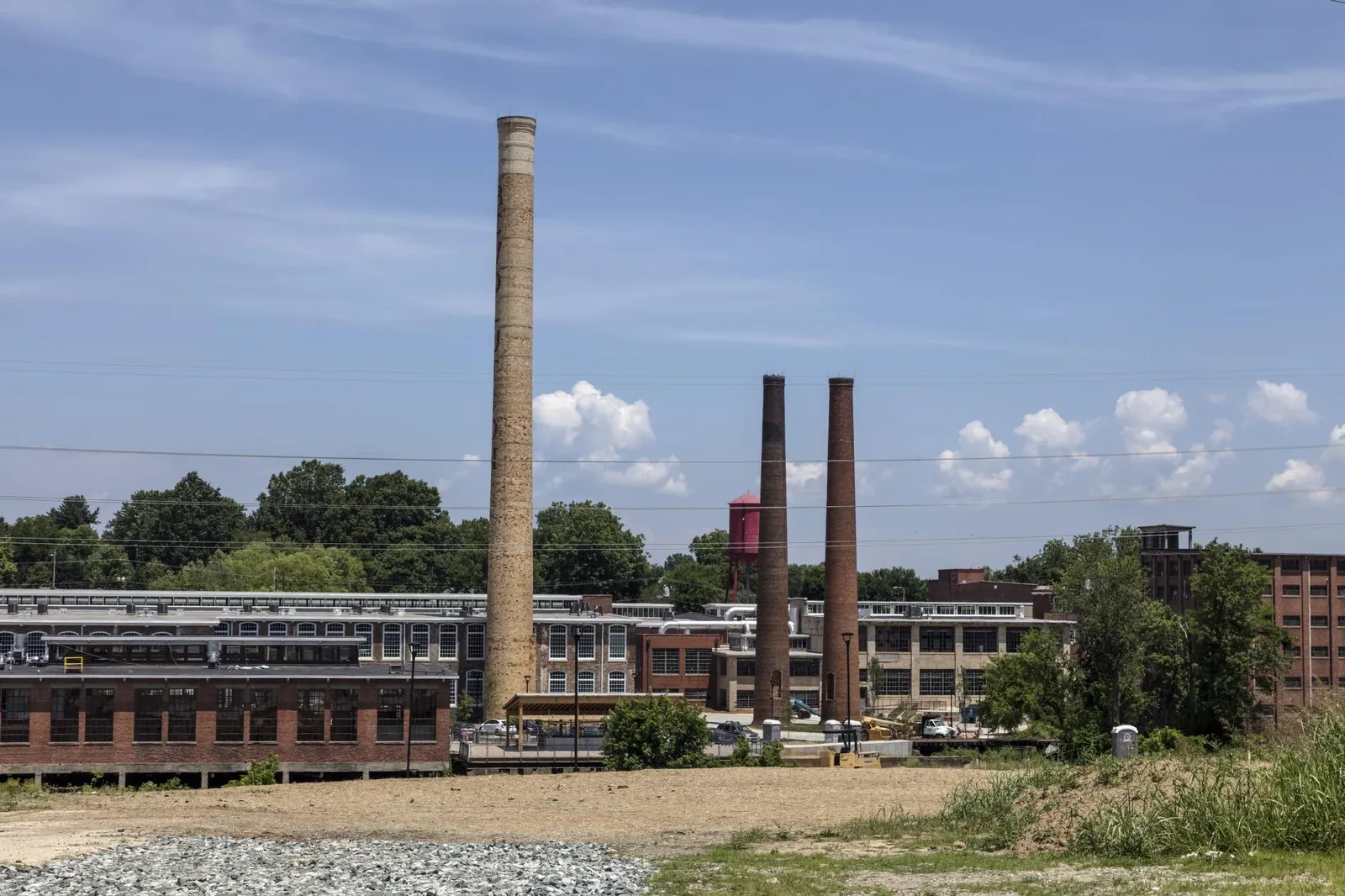
White Oak followed in 1905, built on a plot named for a two-hundred-year-old white oak that stood near the site, and it outgrew Proximity almost immediately. By Cone’s own account, it soon became the world’s largest denim mill, and by 1910 White Oak alone supplied a third of global denim demand.
The 1915 Golden Handshake made White Oak the main supplier of Levi’s raw XX denim. The XX denim was Levi’s top tier, the fabric that would eventually be cataloged as 501XX. The arrangement ran on relationship and reputation, and in one form or another it held for over a century, all the way to the plant’s last day of production.
Everything Under One Roof
A set of commercial stereograph cards from the H. C. White Co., shot between roughly 1907 and 1909, document the plant near the height of its first boom, and together they show the whole production line. Cotton moved through carding, then drawing frames that combined five strands into one, then speeders that drew and twisted two strands together.
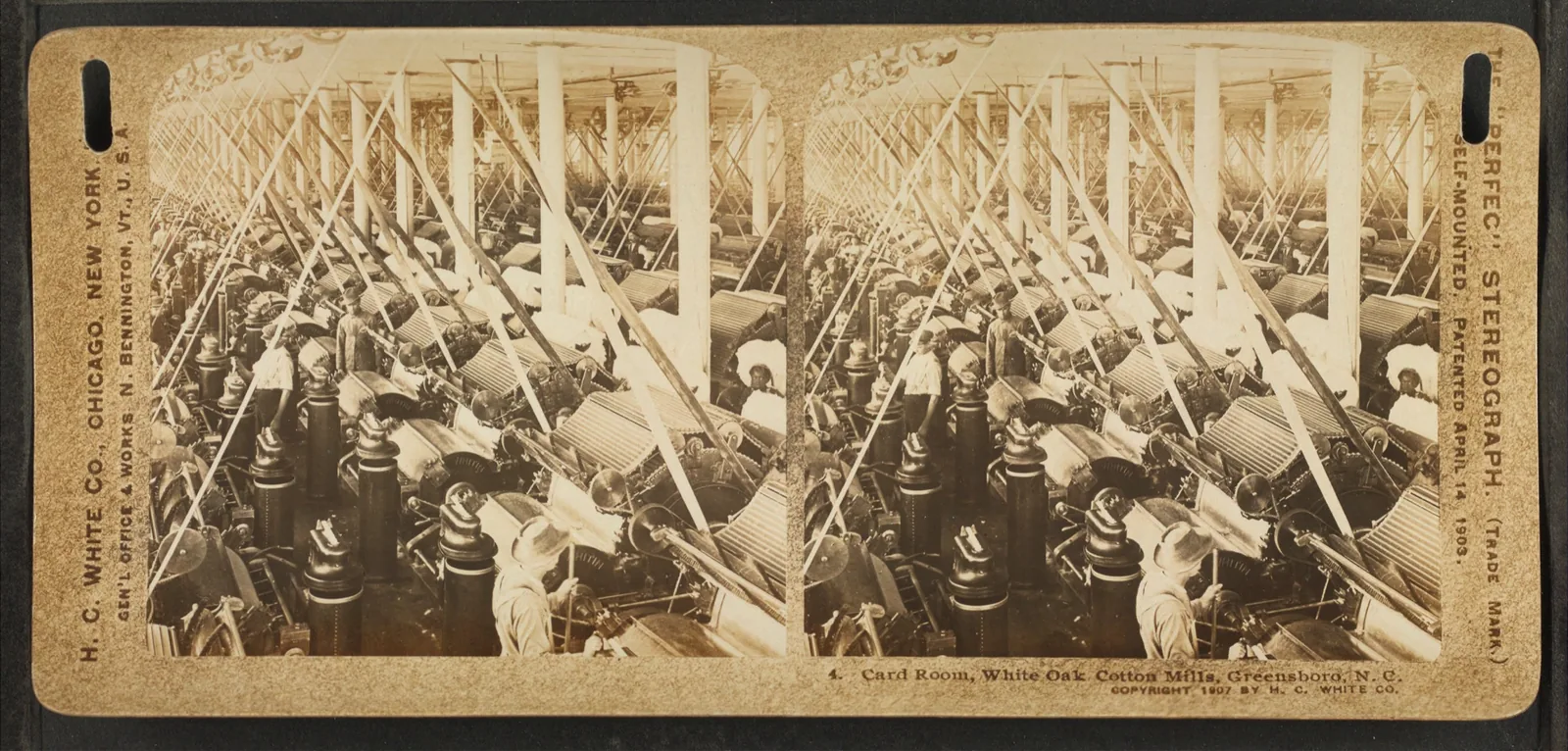
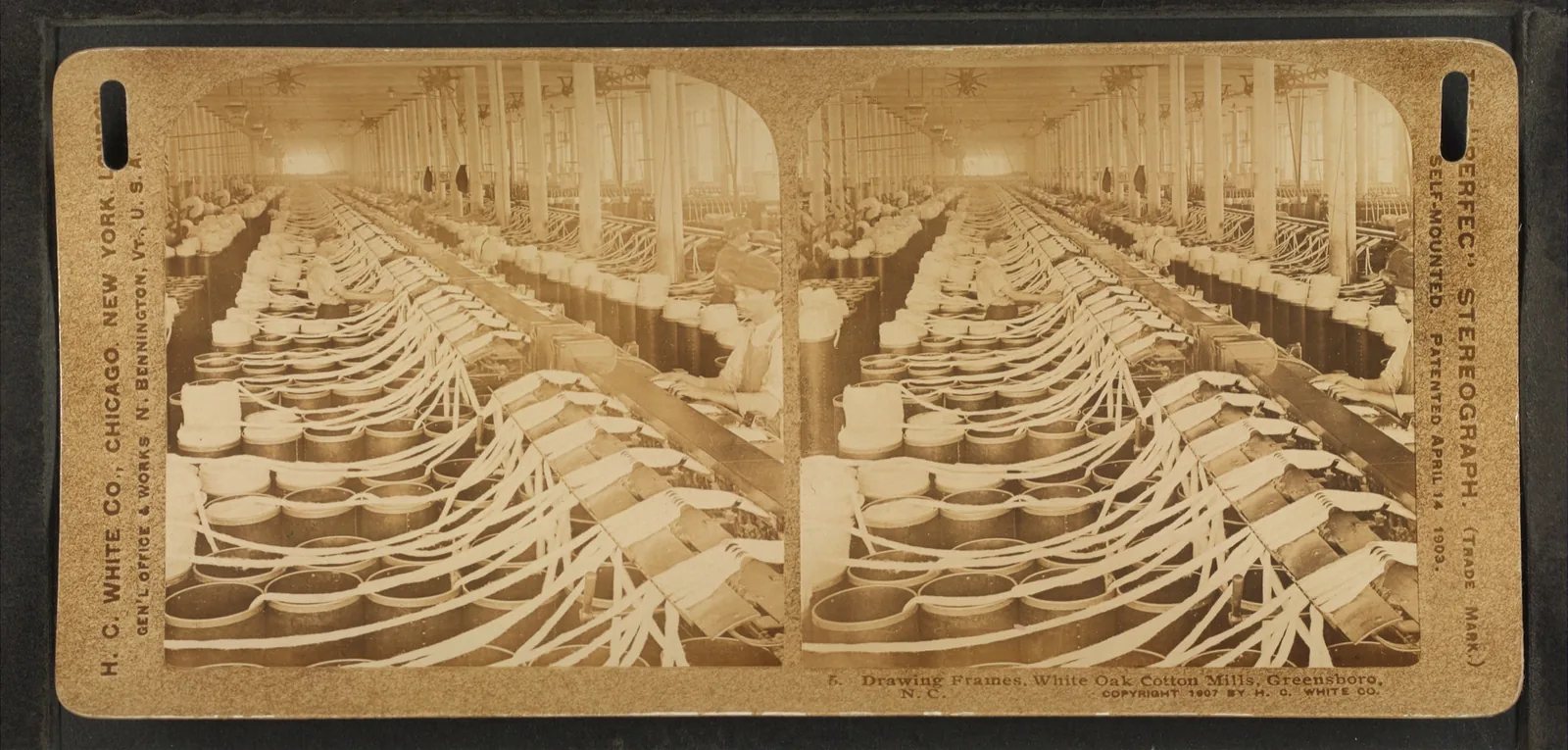
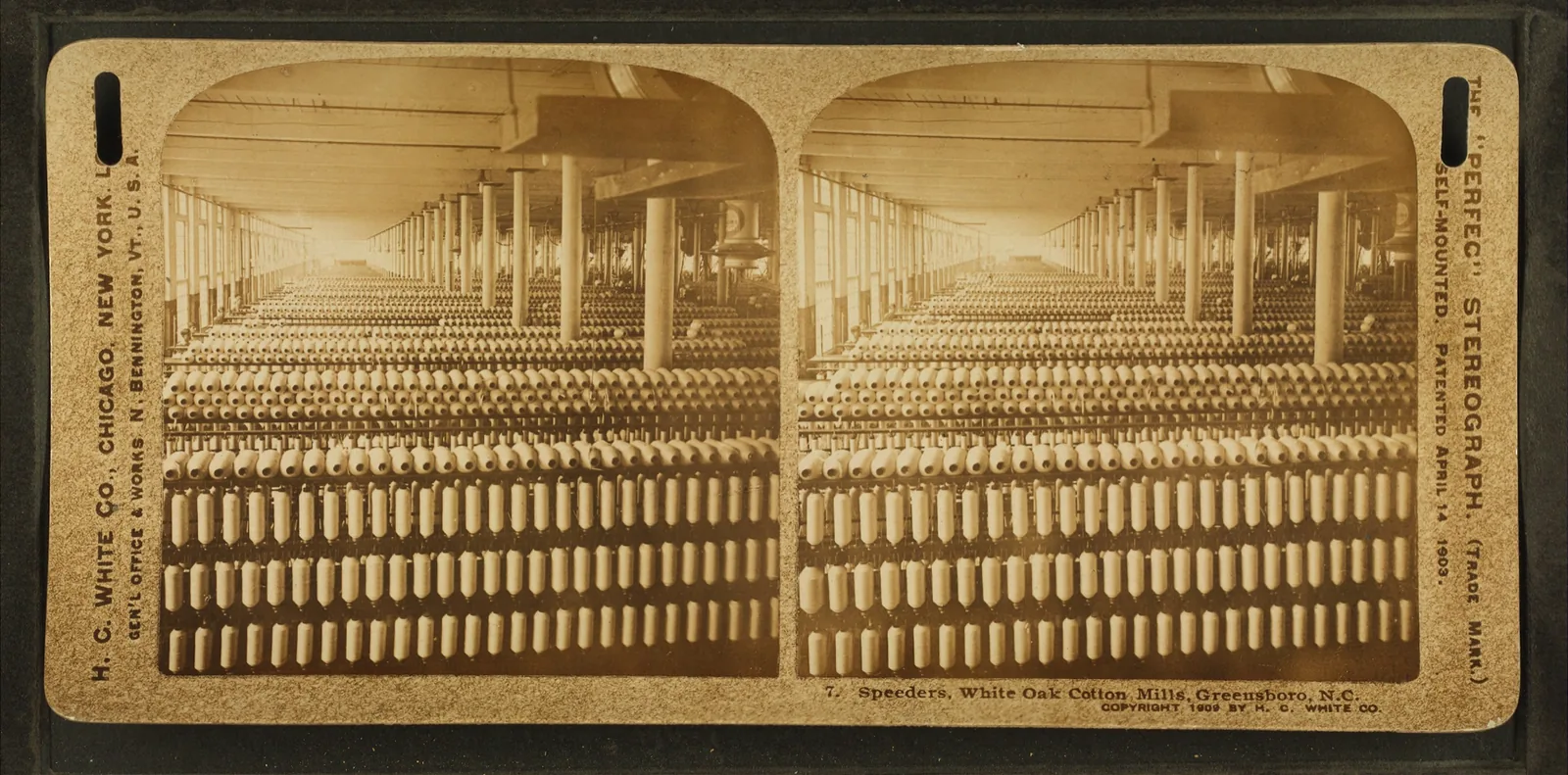
From there it went to spinning (the 1907 card captions that room “60,000 spindles”), then to beaming, where warp threads were straightened and wound for the loom.
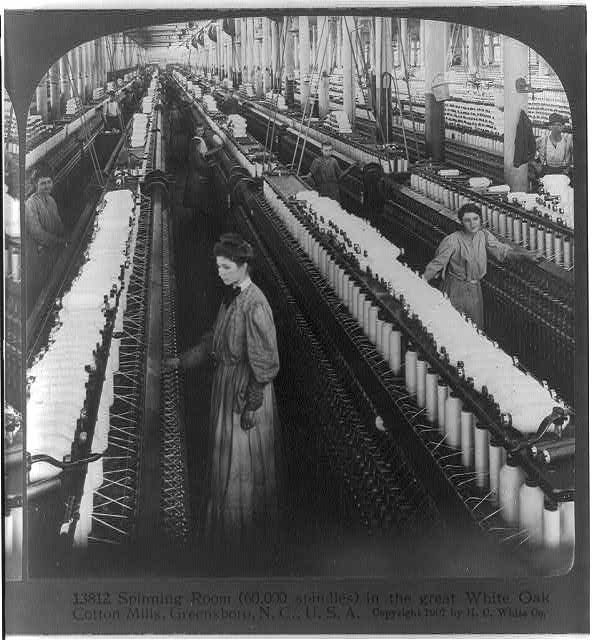
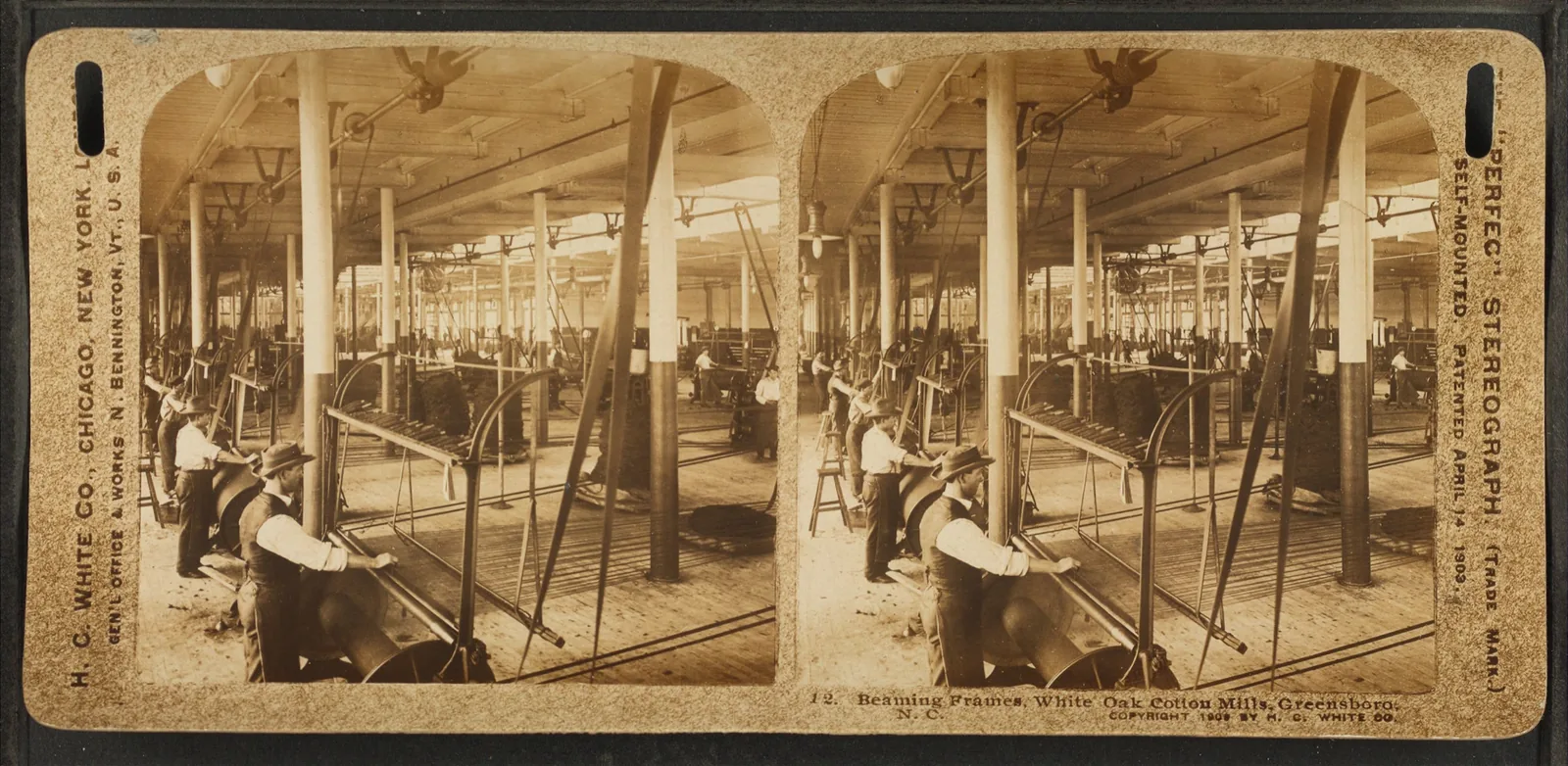
The last two cards show the weave floor itself and a dye house where the yarn was dyed, washed, and dried.
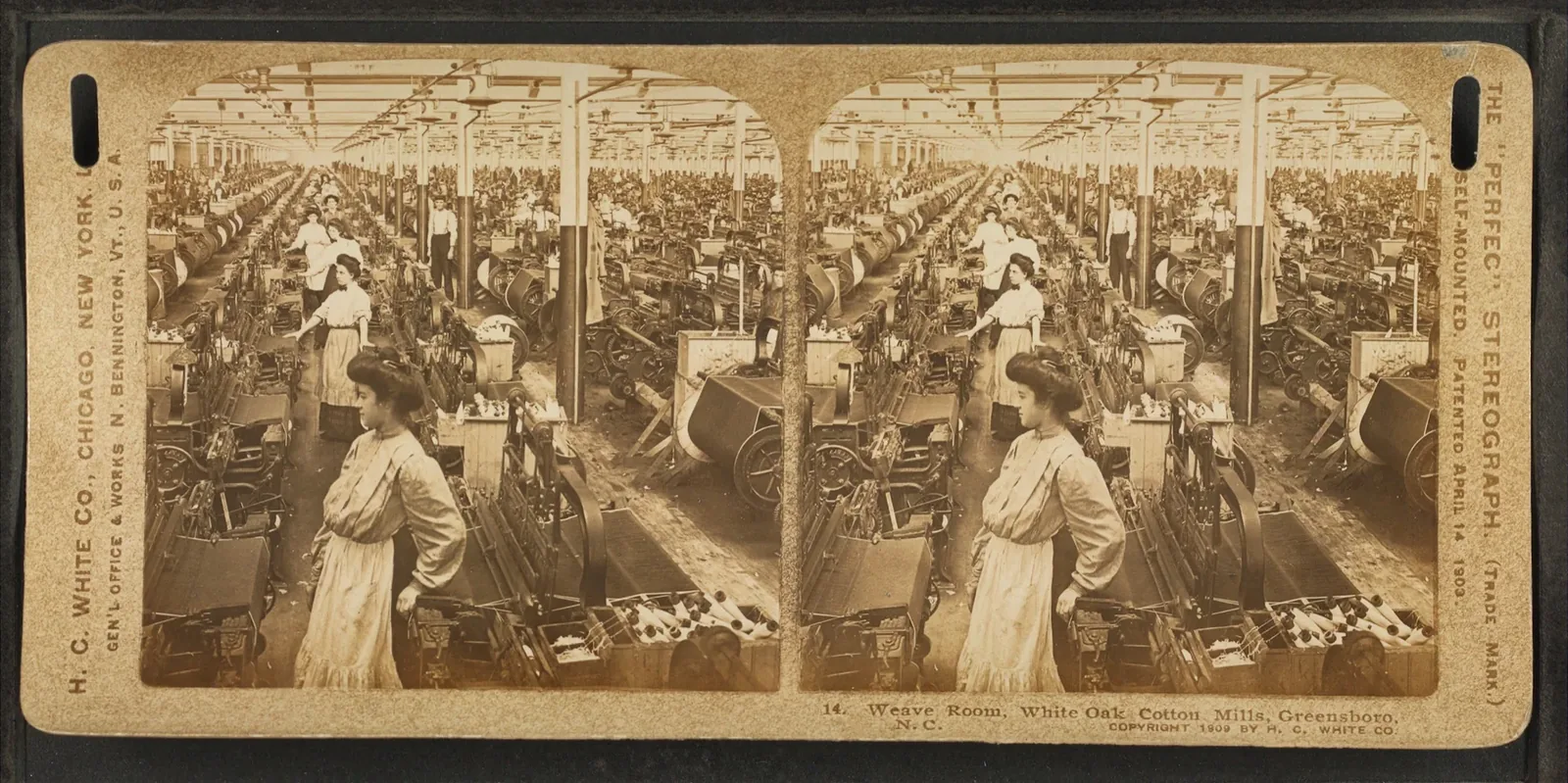
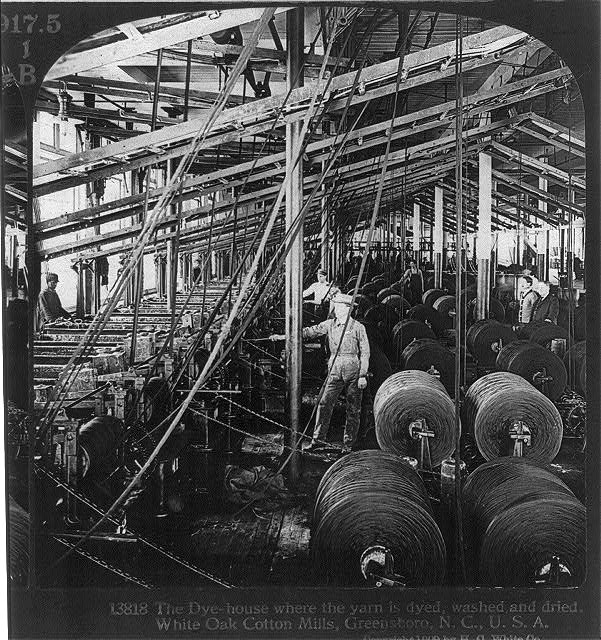
Every stage happened under one roof, at a scale that made White Oak the reference point for what a fully integrated American denim mill was supposed to be.
↑ Table of ContentsWhat Else White Oak Invented
White Oak’s reputation rests on the 501, but the mill didn’t spend its first hundred years making one product. In 1921, Cone engineers developed and patented the Indigo Rope Dye Range at White Oak. This consisted of continuous machinery that dyed twisted ropes of cotton yarn in indigo instead of running it flat through a bath. The same rope-dyeing principle still defines high-contrast denim fading (a deeper explanation of the chemistry of fading appears in The Hidden Work Behind Natural Dyes). In 1932, Cone launched Sanforized denim, using Sanforizer machines to pre-shrink cloth before it ever reached a sewing floor. By then, according to DNR, Cone’s Proximity and White Oak plants together were producing 75 million yards a year. Deeptone Denim followed in 1936, a durable, colorfast finish marketed on its leathery hand-feel. Cone became the first American manufacturer to bring stretch denim to market in 1962, decades before spandex blends were ubiquitous. Around 196,9 hurricane flooding soaked millions of yards of fabric, and the blotchy result was sold as Pinto Wash denim rather than scrapped. In the 1970s, Cone also became the first mill to add skew to denim, twisting the weave so the legs of finished jeans wouldn’t rotate after washing.
For most of the twentieth century, selvedge wasn’t a specialty product at White Oak — it was the only product. Sulzer’s projectile loom didn’t reach the market until 1953, and shuttleless looms didn’t outnumber shuttle looms in American mills until 1989. Over those decades, the mills made workwear denim, stretch denim, and novelty fades. As the American textile industry modernized through the postwar decades and adopted wider, faster projectile looms, mainstream 501 production followed the same shift, and by the mid-1980s the bulk of the denim White Oak wove for Levi’s ordinary mass-market jeans was wide-loom, non-selvedge cloth.
The selvedge denim didn’t disappear entirely with the rise of the projectile looms. It became the specialty end of the business: a shrinking, deliberately maintained bank of shuttle looms kept running specifically to supply Levi’s Vintage Clothing, the line’s historically faithful reproductions of 1947, 1954, and 1966-era 501s, and a handful of American heritage labels like Roy, Tellason, Raleigh Denim, and Left Field NYC.
↑ Table of ContentsWar, Growth, and a Public Company
White Oak’s production shifted during World War II as most of American industry did. Its wartime fabric for the armed forces earned Cone the Army-Navy “E” Award, a citation reserved for plants judged to excel in production for the war effort. In 1945, Cone consolidated its Greensboro textile operations under a single name, Proximity Manufacturing Company, and folded that into the newly formed Cone Mills Corporation in 1948 through a merger with Revolution Cotton Mills. The company went public on the New York Stock Exchange in 1951, opening at $28.58 a share, and spent the following decades diversifying into bleaching, sanforizing, furniture upholstery fabric, and polyurethane cushions on top of the denim that had made its name.
↑ Table of ContentsThe Slow Squeeze
White Oak’s decline took decades, but it wasn’t a straight drop. In 1977, Cone closed the original Proximity Cotton Mill after the EPA sued over pollution. In 1983, Western Pacific Industries, a New York holding company formed in 1970 to buy a railroad, attempted a hostile takeover. It had built up about $16.5 million in Cone stock, and in November it announced plans to buy roughly $30 million more from Ceasar Cone II, a son of co-founder Ceasar Cone. Cone Mills answered with a $465 million leveraged buyout, borrowing $420 million from ten banks and issuing $45 million in new stock to its top executives, with an employee stock ownership plan funded partly from surplus pension money. Forty-seven members of management took the company private in 1984, and Western Pacific dropped its bid and sold its shares for a $23 million profit.
NAFTA eliminated textile tariffs in 1994, and the WTO’s push to end global textile quotas by 2005 doubled the pressure on domestic manufacturing that same decade. Cone’s revenue peaked at about $910 million in 1995, the same year the company posted a net loss of $3.3 million. Bankruptcy followed in 2003, as denim sales kept falling and raw material costs rose. In 2004, financier Wilbur Ross bought Cone for $46 million in cash and merged it with Burlington Mills to form International Textile Group. Ross sold that company to Platinum Equity for $99 million in 2016. A year later, on October 17, 2017, the closure of White Oak was announced, effective that December.
Why Collectors Still Want It
White Oak denim commands its price today because of how it was made: cloth woven on 1940s-era Draper shuttle looms, on the mill’s original wooden floors, by a crew that spent decades perfecting the product. It has the same subtle, unrepeatable texture Mount Vernon later went to considerable lengths to reproduce. White Oak was the exclusive fabric supplier for Levi’s Vintage Clothing’s historically accurate reissues, and the unwashed, “Rigid” versions of those reproductions are especially prized by collectors chasing something as close to the original 1940s and 1950s cloth as a reissue can get. Whatever White Oak fabric or finished garments are still in circulation are a fixed, depleting supply. Every year there is less of it, which is its own kind of quality guarantee.
Small American brands have been cutting jeans from that shrinking supply since the plant closed. Raleigh Denim’s Franklin 1968 is cut from White Oak selvedge that sat in its original factory wrapping for decades. Gustin has offered White Oak deadstock, including a broken twill, through its preorder campaigns. Left Field NYC cut its Chelsea jean from 13-ounce White Oak selvedge, and Freenote Cloth built its Rios jean from “the last rolls” of a 14.5-ounce denim it had co-designed with the mill.
↑ Table of ContentsWhat Happened to the Looms
The Draper X3 is a fly-shuttle loom from the 1940s, built by the Draper Corporation of Hopedale, Massachusetts, once the largest power-loom maker in the United States. Draper’s earlier Northrop loom, first shipped in 1894, automatically swapped in a fresh weft bobbin, letting a single weaver run sixteen looms at once, and Textile World credits Draper’s automatic looms with helping the cotton textile industry move to the South. The X3 throws a shuttle back and forth across the warp about 140 to 160 times a minute, against 400 to 600 for the shuttleless looms that replaced it, and weaves cloth roughly 30 inches wide. Because the shuttle carries each pick of weft all the way across and back, both edges close on themselves, which is what selvedge is. The slower pace also puts less tension on the yarn and tolerates slubs, which is why shuttle-loom denim fades the way collectors want it to.
Draper stopped building looms in the mid-1970s, a few years after control passed to Rockwell International in 1967, so every X3 still running is about half a century old or more and kept alive with salvaged parts. In 2013, with selvedge orders exceeding what its X3s could weave, Cone searched “scrap yards, grassy fields and abandoned mills” for more of them and restored enough to raise White Oak’s selvedge capacity by a quarter.
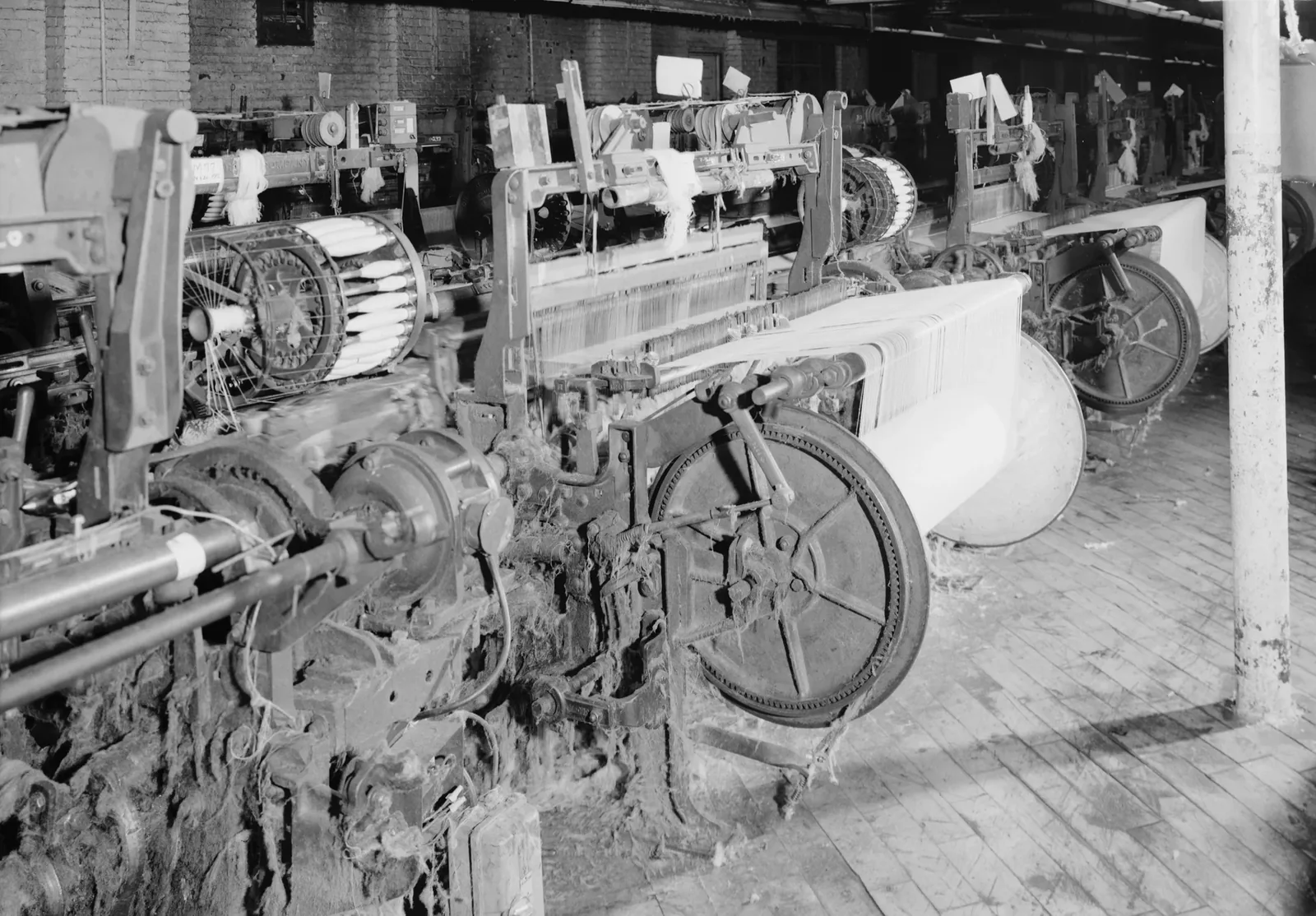
Forty-seven of White Oak’s Draper X3s went to the demolition firm clearing the plant, and in 2019, Vidalia Mills in Louisiana, run by Dan Feibus, bought forty-six of them. The forty-seventh went to the Greensboro Historical Society. Feibus bet a whole company on the idea that American selvedge could be woven again outside Greensboro. Imogene + Willie signed on as Vidalia’s first selvedge customer in 2020, and AG, Raleigh Denim and Left Field NYC followed. Then money problems caught up with it. In October 2024, Vidalia laid off almost a third of its workforce, and the Concordia Parish sheriff scheduled a sale of its land and buildings against roughly $32.5 million in debt. The sale was postponed twice. When it finally happened in August 2025, the top bid of about $1 million fell short of the appraisal, and the property went back to its lenders. The looms weren’t part of it because Vidalia had never owned them outright. For a while, nobody would say publicly who did. Rumors said they had been moved out of the country overnight.
They belonged to KaKa Cotton, a New York financial firm, and in late 2025 Mount Vernon Mills announced a partnership with it to bring them to Georgia. The deal covered forty-five Draper X3 shuttle looms and forty-five Picanol President shuttle looms, bound for the company’s flagship plant in Trion, founded in 1845 and now in its 181st year. Mount Vernon has not disclosed what it paid for the looms.
Company president Bill Rogers explained to Heddels why Mount Vernon’s bet differs from Vidalia’s. “One fallacy I think some people have around these looms is, well, if you’ve got the looms, you can do selvedge,” he said. “No. You have to have those looms, but you have to have everything else too. You have to have the right yarn supply. You have to have the beaming capability, the indigo rope dyeing to get the proper dyeing effect on the yarn. You have to have the proper slashing. You have to have the proper finishing.” When the interviewer suggested that almost three-quarters of the process happens before a shuttle ever moves, Rogers agreed. A standalone selvedge startup doesn’t have that infrastructure. A hundred-eighty-year-old workwear mill already does. Mount Vernon runs plants across four states, weaves about half a million yards a week, and makes far more greige and piece-dyed cloth for workwear and protective fabrics than it does denim. As Rogers put it: “The most recent, they were going to live and die with selvedge. We’re not going to live and die by selvedge denim.”
Mount Vernon had a man hunting Draper parts through storage units and barns for two years, and built a supply room indexed to original Draper part numbers. Looms were triaged into runnable, runnable-but-needs-love, needs-a-full-overhaul, and parts-only. The mill sandblasted large components down to bare metal and repainted them. The mill also brought White Oak retirees out of retirement, housed them near the plant, and put them to work training a new crew, coordinated by Gary Lane, who started his own career decades earlier on Draper X2s at the old Spartan Mills.
They also gave the restored looms a specific room: a building from 1870 with its original wooden floors. A shuttle loom bolted to a wood floor transmits vibration differently than one bolted to a concrete slab, and the resulting harmonics show up in the finished cloth as chatter or marbling. Rogers calls the difference subtle, and he calls that the point.
↑ Table of ContentsTwo Looms Never Left
Two Draper X3s are still running in Greensboro. They were the last looms left in the plant, and Cone Denim donated them to the White Oak Legacy Foundation through a deed of gift. Since 2021, Proximity Manufacturing Company has operated them, which the White Oak Legacy Foundation set up that year as its for-profit arm, with help from two former White Oak workers. On a much smaller scale than either Vidalia or Mount Vernon, Proximity weaves limited runs of selvedge denim at the old White Oak property, and in 2023 it developed two cotton-hemp yarns for its cloth. As far as I know, only one label cuts jeans from that cloth: Seven Titans, whose raw selvedge denim is woven exclusively by Proximity. The site that once supplied a third of the world’s denim now holds a pair of looms doing small-batch, experimental runs.
↑ Table of ContentsWhat’s Left of the Name
Cone Denim, the brand name, still exists, but it no longer weaves in America. Artistic Milliners, a Pakistani manufacturer, took a majority stake from Elevate Textiles in a deal announced in September 2025, and Cone now operates mills in Parras and Yecapixtla, Mexico, and in Jiaxing, China. The name survived, but the Greensboro plant that made that cloth for over a century did not. What survived of Cone Denim left in trucks, in three directions, under three different owners, and at least some of it is running again in an 1870 building in Trion, Georgia